
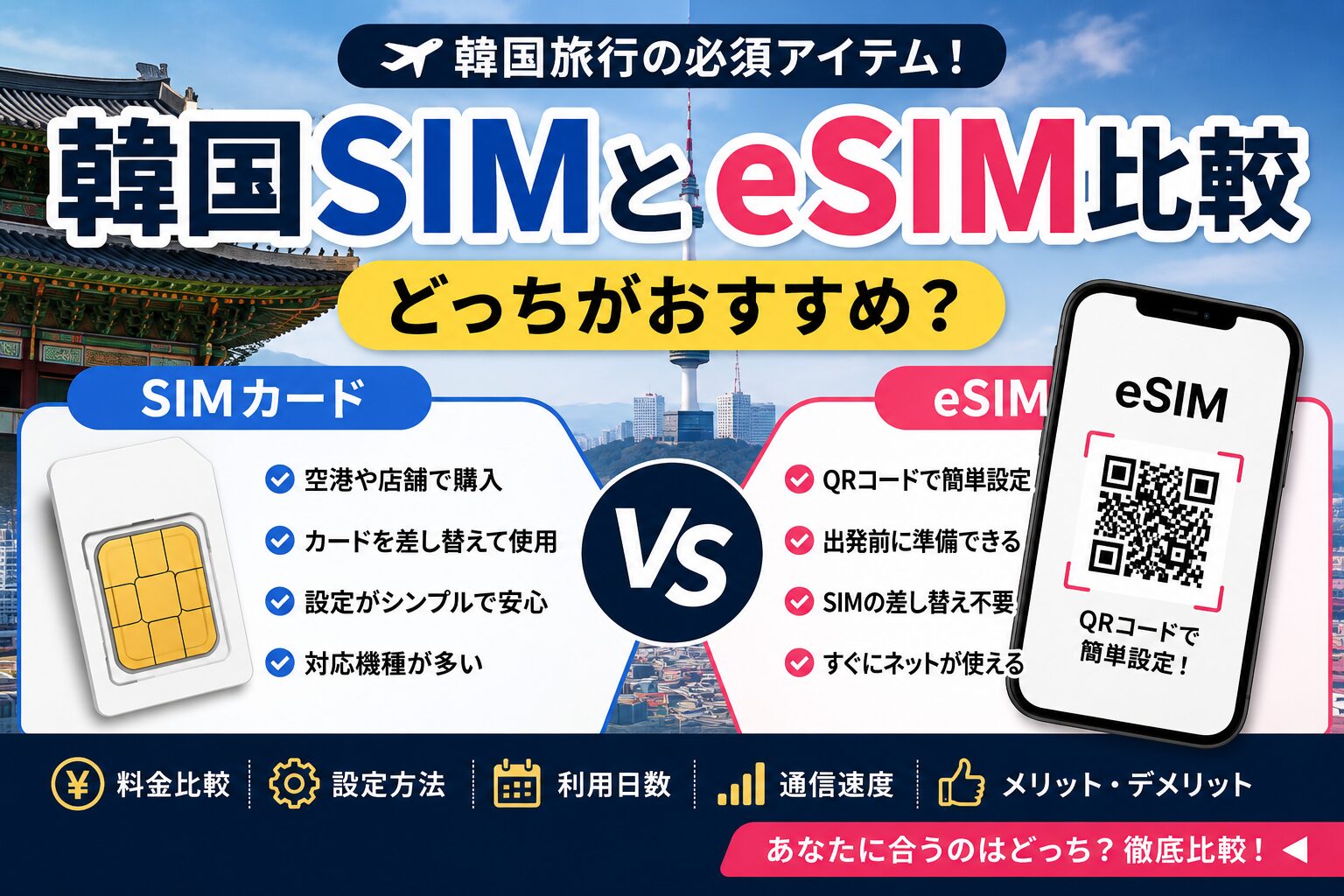
Korea SIM Card vs eSIM: Which Is Better for Travelers?
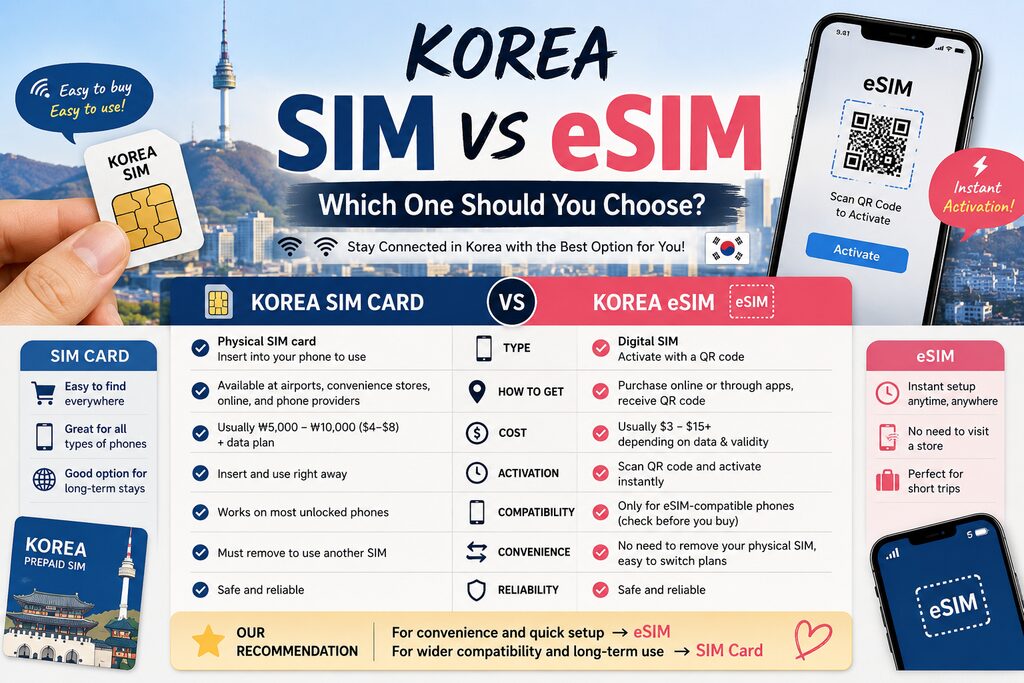
Choosing between a Korea SIM card vs eSIM is one of the first things to consider before traveling to Korea.
You’ll probably use your phone constantly for Naver Map, subway routes, translation, restaurant searches, hotel information, and messaging. Having mobile data ready as soon as you arrive can make your first day much easier.
Both options work well in Korea, but they are better suited to different travelers. Here’s how to decide.
What Is a Korea SIM Card?
A physical Korea SIM card is a small chip that you insert into your smartphone.
Tourist SIM cards are available at international airports, convenience stores, and through online providers. Korea Tourism Organization also notes that prepaid SIM cards for travelers can be purchased at airport convenience stores and other locations around Korea.
Depending on the plan, you may receive mobile data as well as a Korean phone number.
The biggest advantage is compatibility. Many unlocked smartphones support physical SIM cards even if they don’t support eSIM.
The downside is that you’ll need to remove or replace your existing SIM unless your phone supports dual SIM.
What Is a Korea eSIM?
An eSIM works digitally instead of using a physical card.
You usually purchase your plan online and receive installation information or a QR code. Korea Tourism Organization describes prepaid eSIMs as digital plans that can be purchased online and installed by scanning a QR code.
That means you can potentially prepare your mobile connection before arriving in Korea.
There’s no tiny SIM card to lose, and you don’t have to visit a store after landing.
For many short-term travelers, this convenience is the biggest reason to choose an eSIM.
Korea SIM Card vs eSIM: Key Differences
| Physical SIM | eSIM | |
|---|---|---|
| Installation | Insert SIM card | Digital setup |
| Purchase | Airport, stores, online | Mainly online |
| Physical card | Required | Not required |
| Setup before Korea | Limited | Usually possible |
| Phone compatibility | Wider | eSIM-compatible phones only |
| Keep original SIM | Depends on phone | Usually easier |
| Good for short trips | Yes | Excellent |
| Korean number | Available on some plans | Depends on plan |
The most important difference in the Korea SIM card vs eSIM comparison isn’t necessarily internet speed. It’s convenience and compatibility.
Why I Recommend eSIM for Most Travelers
For a typical short trip to Korea, I would choose an eSIM.
You can arrange it before departure, keep the eSIM information on your phone, and avoid spending part of your arrival time looking for a SIM counter.
This is particularly convenient after a long flight into Incheon Airport.
Once your connection is working, you can immediately check transportation, your hotel location, maps, and messages.
Korea also has extensive public Wi-Fi at places such as airports and subway and train stations, but having your own mobile data is much more convenient while moving around.
When a Physical SIM Is Better
A physical SIM still makes more sense in several situations.
Choose a physical SIM if your smartphone doesn’t support eSIM, if you prefer having staff help with setup, or if you’ve found a tourist SIM plan that better matches your needs.
It can also be useful if having a Korean phone number is important to you.
However, don’t assume every physical SIM automatically includes calls, texts, and a Korean number. Check exactly what your plan includes before purchasing.
Check Your Phone Before Buying an eSIM
This is important.
Not every smartphone supports eSIM, and compatibility can differ by model, country, and carrier.
Your phone should also be unlocked for use with another mobile network.
Before purchasing anything, check:
- Whether your phone supports eSIM
- Whether your phone is carrier-unlocked
- Whether the plan includes data only or calls and texts
- How long the plan remains valid
- When the validity period begins
- Whether tethering or hotspot use is allowed
Checking these details before your flight can prevent problems after landing.
Do You Need a Korean Phone Number?
Not every tourist needs one.
If you’re mainly using maps, translation apps, social media, messaging, and general web browsing, a data-focused eSIM may be enough.
However, certain services or reservations can be easier with a Korean number.
If you specifically need calls, SMS, or a local number, compare the plan details rather than simply choosing between SIM and eSIM.
The included services matter more than the format itself.
Can You Buy a SIM After Arriving in Korea?
Yes.
Physical tourist SIM cards are available after arrival, including at international airports and various convenience-store locations.
This makes a physical SIM a useful backup if you arrive without arranging mobile data beforehand.
Some Korean airports also provide SIM/eSIM purchasing options through mobile carrier counters or stores; for example, Korea Tourism Organization’s current Jeju Airport guide specifically notes both options are available there.
Which Should You Choose?
For most short-term tourists:
Choose eSIM if you want maximum convenience.
It’s especially suitable if you:
- Have an eSIM-compatible smartphone
- Want to prepare before departure
- Don’t want to swap physical SIM cards
- Mainly need mobile data
- Are visiting Korea for a short trip
Choose a physical SIM card if you:
- Don’t have eSIM support
- Prefer in-person setup
- Want wider device compatibility
- Need a particular Korean phone-number plan
- Prefer using a traditional SIM
Korea SIM Card vs eSIM: Final Recommendation
When comparing a Korea SIM card vs eSIM, there isn’t one perfect choice for everyone.
For most tourists visiting Korea for a few days or a week, eSIM is my first recommendation because of its convenience. You can arrange your connection before your trip and avoid changing physical SIM cards after arrival.
A physical SIM remains an excellent option for travelers with older devices, anyone who prefers assistance at a store, or travelers who need a specific local-number plan.
Whichever you choose, set up your mobile connection early. Once you can access maps, transportation information, translation, and hotel details, traveling around Korea becomes much easier.
Related Articles
10 Things Not to Do in Korea: Essential Etiquette for Tourists