
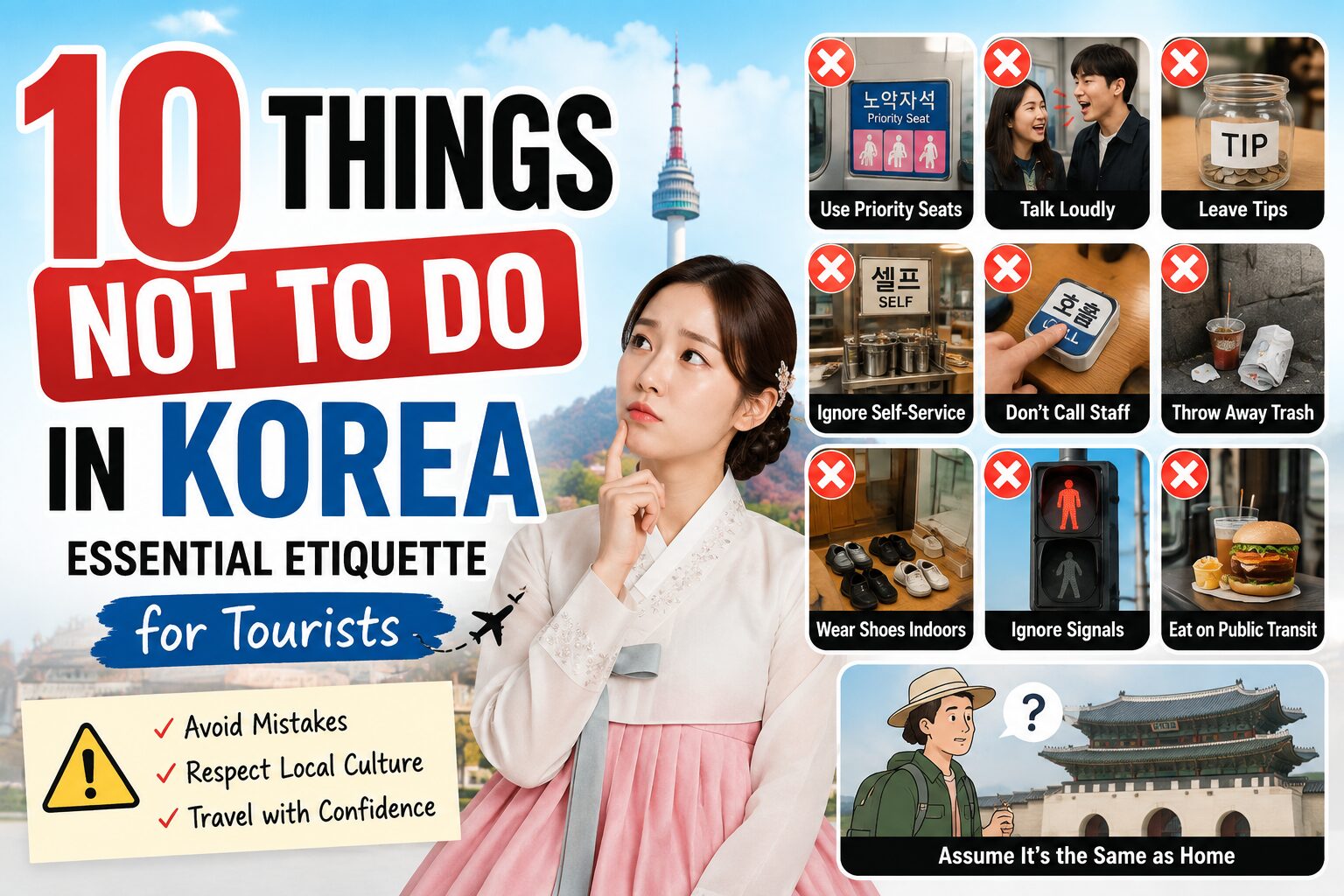
10 Things Not to Do in Korea
Korea may feel similar to Japan in some ways, but there are a few different rules, customs, and everyday manners that travelers should know. If you are unfamiliar with them, you may occasionally find yourself wondering what to do.
That said, you do not need to memorize every cultural rule before your trip. From a Korean perspective, here are 10 things you should avoid when traveling in Korea, along with some useful etiquette tips for international visitors.
1. Sitting in Priority Seats on the Subway
Korean subways have priority seats for elderly passengers, people with disabilities, and others who may need them.
Even when these seats are empty, many passengers choose to use regular seats instead. As a traveler, it is generally best to do the same.
There are also designated seats for pregnant passengers, so pay attention to the signs, especially when the train is crowded.
2. Talking Loudly on Subways and Buses
You will see plenty of people using their smartphones on Seoul’s subways and buses, but loud conversations or playing videos and music through your phone’s speaker are best avoided.
Public transportation can become especially crowded during the morning and evening rush hours. If you are carrying a backpack or large suitcase, be mindful of the space around you.
3. Leaving a Tip at Restaurants
Tipping is generally not expected in Korea.
At most restaurants and cafés, simply pay the amount shown on your bill. There is no need to leave additional money on the table after your meal.
If you come from a country where tipping is common, this is one part of Korean dining culture that can take some getting used to.
4. Missing the Self-Service Area at Restaurants
Some Korean restaurants have self-service areas for water, side dishes, utensils, and other items.
If water is not brought to your table immediately, you may not need to call a staff member.
Look around for a self-service station, often marked with the Korean word “셀프,” before asking for assistance.
5. Waiting Too Long for Restaurant Staff
Many restaurants in Korea have a call button on the table that you can press when you are ready to order or need something.
If there is no button, it is also common to get a staff member’s attention by saying “저기요 (jeogiyo),” which is similar to saying “Excuse me.”
If you simply wait for someone to come to your table, you could end up waiting longer than expected.
6. Leaving Trash on the Street
Public trash cans can sometimes be difficult to find in Korea, particularly on certain streets.
That does not mean it is acceptable to leave empty cups, food containers, or other trash behind.
If you cannot find a trash can nearby, keep your trash with you until you find an appropriate disposal area at a station, shopping mall, or other public facility.
7. Wearing Shoes Inside Homes and Certain Places
Shoes are normally removed before entering a Korean home.
You may also be asked to remove your shoes at traditional hanok buildings, certain restaurants, guesthouses, and other accommodations.
If you see a shoe rack near the entrance or notice everyone else taking off their shoes, check before walking inside.
8. Ignoring Pedestrian Signals
You will probably spend a lot of time looking at maps while walking around Korea, but always pay attention to pedestrian signals when crossing the road.
Major intersections in Seoul can be very wide, and some crossings take longer than you might expect.
Rather than rushing across when the signal is about to change, it is safer to wait for the next green light.
9. Eating Strong-Smelling Food on Public Transportation
Carrying a drink while traveling is one thing, but opening a full meal or strong-smelling food on a subway or bus is best avoided.
If you buy food from a traditional market or street-food stall, it is usually better to enjoy it nearby or in a designated eating area rather than taking it onto public transportation.
Being considerate of other passengers is one of the easiest rules to follow while traveling around Korea.
10. Assuming Everything Works the Same as at Home
Korea may feel familiar in many ways, but restaurant service, public transportation, payment methods, and everyday customs can work differently from what you are used to.
Instead of assuming things will work exactly the same way as they do at home, take a moment to observe what people around you are doing.
If you are unsure, using a translation app to ask a simple question can also help.
Korean Travel Etiquette Doesn’t Have to Be Complicated
The phrase “things you shouldn’t do in Korea” might sound intimidating, but there is really no need to worry too much.
As long as you follow basic public manners, most situations are easy to handle.
Knowing a little about priority seating, public transportation etiquette, restaurant self-service systems, and other everyday differences can make your trip much smoother.
Keep these tips in mind before your trip, observe how locals behave when you are unsure, and focus on enjoying Korea’s food, culture, and attractions.