
Korea Travel Etiquette You Should Know
Understanding a few basic rules of Korea travel etiquette can make your trip much easier.
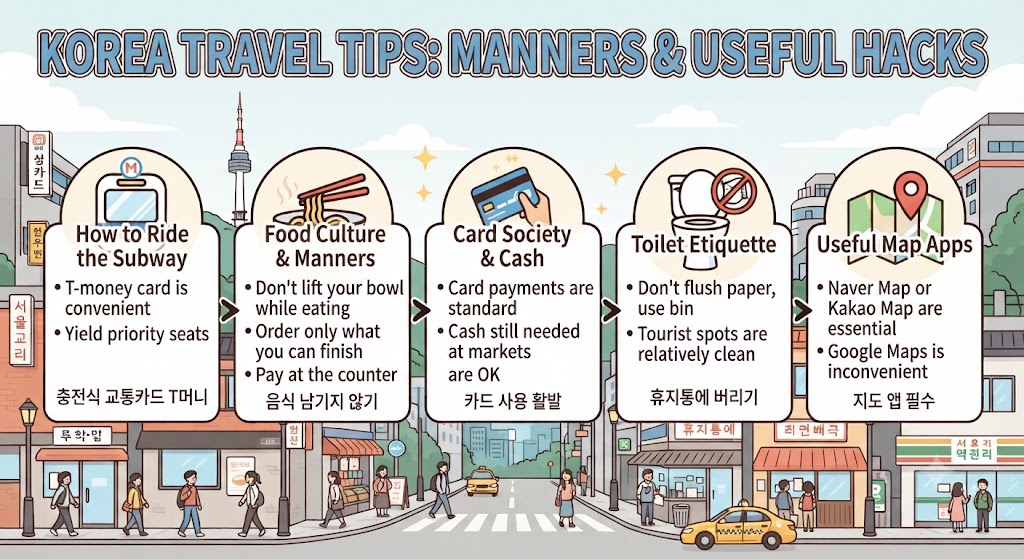
Most visitors quickly adapt to everyday life in Korea, but subway manners, restaurant customs, payments and public toilets can work differently from what you are used to.
Here are four practical things worth knowing before your trip.
1. Subway Etiquette in Korea
Seoul’s subway is convenient, but there are a few unwritten rules.
Seats at the ends of subway cars are generally reserved for elderly passengers, pregnant women and people with disabilities. It is better to leave priority seats available when possible.
People also tend to keep conversations relatively quiet on trains.
When boarding, wait for passengers to exit before entering. During rush hour, especially around 7–9 a.m. and 5–7 p.m., trains can become extremely crowded.
One useful Korea travel etiquette tip is to stand to the side of the doors while people are getting off.
2. Restaurant Etiquette in Korea
Korean restaurants are generally casual, so tourists do not need to worry too much about complicated dining rules.
At many restaurants, water, utensils and side dishes may be self-service. Look for a self-service station or observe what other customers are doing.
Some restaurants have a call button on the table that you can press when you need a staff member.
Tipping is also generally not expected at ordinary Korean restaurants.
Another useful Korea travel etiquette rule is that some restaurants, particularly barbecue restaurants, may require a minimum order such as two portions of meat.
Check the menu before ordering if you are dining alone.
3. Card Payments in Korea
Credit and debit cards are widely accepted throughout South Korea.
Hotels, convenience stores, cafés, restaurants, department stores and most tourist attractions generally accept card payments.
Contactless payment availability can vary, so carrying a physical card is useful.
You should also keep a small amount of Korean won in cash.
Traditional markets, small street-food stalls and some older businesses may still prefer or require cash.
For public transportation, travelers commonly use transportation cards such as T-money.
A simple combination of credit card + transportation card + a small amount of cash works well for most trips.
4. Public Toilets in Korea
Finding a toilet in Korea is usually relatively easy in major cities.
Subway stations, department stores, shopping malls, tourist attractions and large cafés often have restrooms.
One practical tip is to look for subway stations or large commercial buildings when you urgently need a toilet.
Most modern toilets allow toilet paper to be flushed normally. However, if a specific restroom displays instructions asking users to place paper in a bin, follow the posted instructions.
Public restrooms are another reason learning a few Korea travel etiquette basics before arriving can make everyday travel easier.
Quick Korea Travel Tips
For a smoother trip, remember these basics:
Subway: Let passengers exit first and respect priority seating.
Restaurants: Check whether water and side dishes are self-service.
Payments: Cards are widely accepted, but keep some cash.
Toilets: Subway stations and shopping malls are reliable places to look.
These small habits can prevent many common inconveniences for first-time visitors.
Final Thoughts
You do not need to memorize dozens of cultural rules before visiting Korea.
Most Korea travel etiquette is simply about observing the people around you and following signs when instructions are provided.
Understanding subway manners, Korean restaurant culture, card payments and public toilets is already enough to make everyday situations much easier.
Once you know these basics, traveling around Korea becomes surprisingly straightforward.