

Korean BBQ Etiquette: How to Eat Korean Barbecue Like a Local
Understanding Korean BBQ etiquette makes your first Korean barbecue experience much easier.
When you sit down, you may suddenly have a grill, several side dishes, raw meat, scissors, tongs and lettuce in front of you.
Then comes the confusing part.
Who cooks the meat? How much should you order? Which utensils are for raw meat? Are the side dishes free? And should you tip?
The system is much simpler once you know a few basic rules.
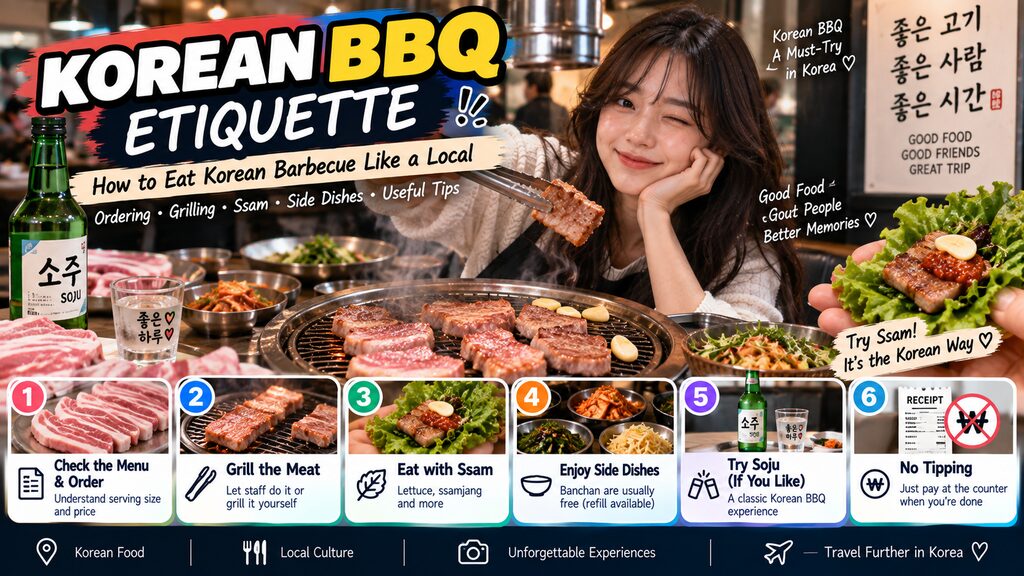
1. Check the Minimum Order Before Sitting Down
Many Korean barbecue restaurants sell meat by serving.
You might see:
삼겹살 1인분 — Samgyeopsal, one serving
One serving does not always mean one complete meal for one person.
Some restaurants require a minimum initial order of two servings, especially for meat.
For example:
2 people → usually order at least 2 servings
Solo travelers should check before entering because some barbecue restaurants are designed mainly for groups.
2. Understand the Price Per Serving
Always check the amount listed next to the price.
A menu may show something like:
삼겹살 180g — ₩17,000
That means you’re paying for one 180g serving.
If you order three servings, the price is multiplied accordingly.
This is one reason Korean barbecue can become more expensive than expected if you keep adding meat without checking the menu.
3. Who Cooks the Meat?
This depends on the restaurant.
Some restaurants have staff who:
- Place the meat on the grill
- Cut it with scissors
- Turn it
- Tell you when it’s ready
At other restaurants, customers cook everything themselves.
The easiest rule:
Wait a few seconds before touching the grill.
If the server begins cooking, let them handle it.
If they place the meat down and walk away, you’re probably expected to continue grilling.
4. Don’t Use Your Eating Chopsticks for Raw Meat
This is one of the most useful practical rules.
Korean barbecue tables often provide:
집게 — tongs
and
가위 — scissors
Use these for handling and cutting raw or cooking meat.
Use your regular chopsticks for eating cooked food.
Avoid repeatedly touching raw pork or beef with chopsticks that then go directly into your mouth.
5. Cut Meat with Scissors
Yes, scissors at the dinner table are completely normal.
Korean barbecue restaurants commonly provide kitchen scissors because they’re much easier than using a knife on the grill.
Cook the meat until it’s easier to handle, then cut larger pieces into bite-sized portions.
Don’t be surprised if the server suddenly starts cutting your pork belly with scissors.
That’s normal Korean barbecue service.
6. Don’t Overload the Grill
You don’t need to put every piece of meat on the grill at once.
If you overcrowd it, the meat can cook unevenly and become harder to manage.
Cook enough for the table, eat it while it’s hot, then add more.
This is particularly useful when eating fatty meat such as samgyeopsal because the grill can quickly fill with oil.
7. The Server May Change Your Grill Plate
During the meal, the grill can become covered with burnt sauce or fat.
A server may suddenly arrive and replace the grill plate.
You usually don’t need to ask.
And don’t worry—they aren’t trying to end your meal.
They’re simply giving you a clean surface so the next round of meat tastes better.
8. Learn How to Make a Ssam
One of the best parts of Korean barbecue is:
쌈 — ssam
A typical ssam might include:
Lettuce
↓
Cooked meat
↓
Ssamjang
↓
Garlic
↓
Kimchi or green onion salad
↓
Fold everything together and eat it.
You don’t have to use every ingredient.
Make the combination you like.
9. Try to Eat the Ssam in One Bite
Traditionally, ssam is usually made small enough to eat in one bite.
If you build a giant lettuce wrap that’s impossible to eat without falling apart, you’ve probably added too much.
Start small.
One leaf + one piece of meat + a little sauce is enough.
10. What Is Ssamjang?
You’ll usually see a thick brown or reddish paste on the table.
That’s:
쌈장 — ssamjang
It’s commonly eaten with grilled meat and lettuce wraps.
You may also see:
소금 — salt
참기름 — sesame oil
마늘 — garlic
Different meats work well with different sauces.
There isn’t one strict correct combination.
11. Banchan Are Part of the Meal
Korean barbecue tables often fill up quickly with:
- Kimchi
- Pickled radish
- Green onion salad
- Garlic
- Lettuce
- Other side dishes
These are called:
반찬 — banchan
Standard side dishes are generally included with the meal.
At many restaurants, you can request more or refill them at a self-service station.
But don’t take huge amounts you’re not going to eat.
Refill a little at a time.
12. Look for the Self-Service Area
Some restaurants have a section marked:
셀프
That means self-service.
You may find:
- Lettuce
- Kimchi
- Sauces
- Water
- Plates
- Side dishes
If nobody brings more lettuce after you finish it, look around before calling the server.
You may simply be expected to refill it yourself.
13. Use the Call Button or Say Jeogiyo
Many Korean restaurants have a button on the table.
Press it if you need:
- More meat
- Drinks
- Extra dishes
- The server
No button?
Say:
저기요! — Jeogiyo!
Meaning roughly:
“Excuse me!”
This is completely normal.
You don’t need to sit silently waiting until somebody notices you.
14. Order Rice or Noodles Near the End
Many Koreans don’t necessarily start the barbecue meal with a bowl of rice.
After eating meat, people often order something such as:
볶음밥 — fried rice
냉면 — cold noodles
된장찌개 — soybean paste stew
These can act almost like the final course.
Cold noodles after fatty grilled pork are especially popular because the flavors contrast nicely.
15. Don’t Forget Korean BBQ + Soju
Alcohol is common at Korean barbecue restaurants, especially:
소주 — soju
and
맥주 — beer
You may also hear:
소맥 — somaek
which mixes soju and beer.
You absolutely do not need to drink alcohol to enjoy Korean BBQ.
If you don’t drink, simply order water or another beverage.
16. Drinking Etiquette Is More Important in Formal Groups
If you’re eating casually with friends, don’t overthink Korean drinking etiquette.
But when dining with older Korean people or in a more formal setting, traditional manners may include:
- Pouring drinks for others
- Using two hands when giving or receiving a drink
- Letting older people begin first
- Turning slightly away when drinking in front of elders
Foreign tourists aren’t expected to perform every traditional rule perfectly.
Being polite is enough.
17. Don’t Assume Every Korean BBQ Restaurant Uses Charcoal
Some restaurants use:
- Charcoal
- Gas
- Electric grills
- Built-in tabletop grills
Charcoal isn’t automatically better.
Different restaurants use different systems depending on the meat and concept.
The important thing is whether the restaurant handles the meat well.
18. Clothes May Smell Like BBQ
This is something many first-time visitors don’t expect.
Grilling meat at your table means your clothes, coat and hair may smell like barbecue afterward.
Some Korean restaurants provide:
- Storage bags
- Coat covers
- Lockers
- Under-chair storage
Use them if available.
If you’re planning a fancy evening afterward, Korean barbecue may be better as the final activity.
19. Don’t Expect a Tip
One of the simplest parts of Korean BBQ etiquette is tipping.
You generally do not need to leave an additional percentage for the server.
If the meal costs ₩60,000, you normally pay ₩60,000.
You don’t need to calculate another 15–20% at checkout.
20. You Usually Pay at the Counter
When you’re finished, don’t necessarily wait for a bill to arrive at the table.
In many Korean barbecue restaurants, you walk to the cashier near the entrance and pay there.
Say:
계산할게요. — Gyesanhalgeyo.
“I’d like to pay.”
Cards are widely accepted at established restaurants, though keeping another payment method available while traveling is always useful.
Useful Korean BBQ Phrases
| Korean | Meaning |
|---|---|
| 이거 주세요 | This one, please |
| 삼겹살 2인분 주세요 | Two servings of samgyeopsal, please |
| 더 주세요 | More, please |
| 상추 더 주세요 | More lettuce, please |
| 불판 바꿔 주세요 | Please change the grill plate |
| 이거 다 익었어요? | Is this fully cooked? |
| 덜 맵게 해 주세요 | Please make it less spicy |
| 물 주세요 | Water, please |
| 계산할게요 | I’d like to pay |
| 감사합니다 | Thank you |
You don’t need to memorize all of them.
A menu, pointing and a translation app will solve most situations.
Korean BBQ Etiquette Quick Checklist
Before ordering:
✓ Check the price per serving
✓ Check minimum order requirements
While grilling:
✓ Use tongs for raw meat
✓ Wait to see whether staff grill for you
✓ Don’t overload the grill
While eating:
✓ Try meat with ssam
✓ Refill banchan only as needed
✓ Check for a self-service station
After eating:
✓ Consider cold noodles or fried rice
✓ Pay at the counter
✓ No tip is generally necessary
That’s basically everything a first-time visitor needs.
FAQ
How much Korean BBQ should two people order?
A common starting point is around two servings of meat, then add more depending on appetite and side dishes.
Does the server cook Korean BBQ for you?
Sometimes. It depends on the restaurant. Wait and see what the staff does before taking control of the grill.
Are Korean BBQ side dishes free?
Standard banchan are usually included, and many restaurants offer refills.
Can one person eat Korean BBQ alone?
Yes at some restaurants, but minimum-order rules can make certain places less convenient for solo diners.
Do you tip at Korean BBQ restaurants?
Generally, no.
What meat should first-time visitors try?
Samgyeopsal—pork belly—is one of the easiest and most classic starting points.
Final Thoughts
Learning Korean BBQ etiquette isn’t about memorizing dozens of strict cultural rules.
For tourists, the practical basics matter more.
Check the number of servings, use tongs for raw meat, wait to see whether the staff cooks for you, try a lettuce wrap, use the call button when you need something and pay at the counter when you’re finished.
Once you understand those basics, Korean barbecue becomes one of the easiest—and most enjoyable—meals to experience in Korea.
Related Articles
MY NOTE!