
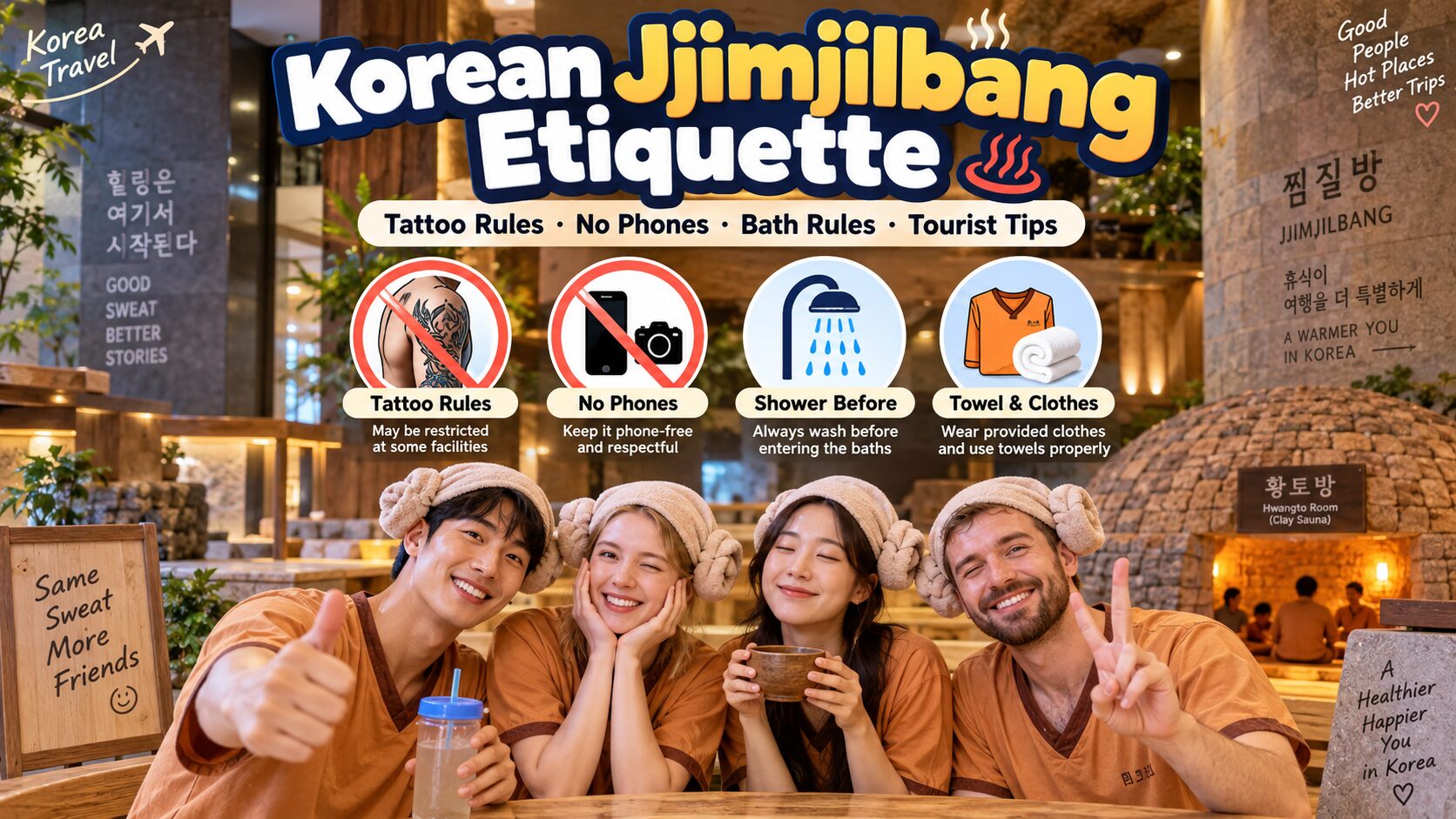
Korean Jjimjilbang Etiquette: 10 Things You Should Never Do
Understanding Korean jjimjilbang etiquette before your first visit can prevent some extremely awkward situations.
A Korean jjimjilbang usually combines gender-separated bathing areas with shared sauna and relaxation spaces.
For Koreans, the system feels completely normal.
For international visitors, however, questions immediately appear.
Can you wear a swimsuit in the bath?
Can you take your phone inside?
What happens if you have tattoos?
Where do you get towels and sauna clothes?
Most mistakes are easy to avoid once you understand a few basic rules.

| Situation | What You Should Do | What to Avoid |
|---|---|---|
| Tattoo | Check the facility’s policy before visiting | Assuming every spa has the same rule |
| Locker room | Keep your phone/camera stored | Photos or video |
| Bath area | Shower first | Entering the bath without washing |
| Jjimjil area | Wear provided sauna clothes | Walking around nude |
| Public bath | Follow the facility’s bath rules | Wearing jjimjil clothes into the bath |
| Locker key | Keep it on your wrist/ankle | Losing or exchanging keys |
| Sauna rooms | Start at a comfortable temperature | Staying too long in extreme heat |
| Towels | Use what the facility provides | Taking excessive towels |
| Shared spaces | Keep noise reasonable | Loud calls or shouting |
| Exit | Settle extra charges and return the key | Walking out without checkout |
1. Don’t Assume Tattoos Are Always Allowed
Tattoo rules are one of the biggest sources of confusion for foreign visitors.
There isn’t one simple rule you should assume applies to every jjimjilbang.
Individual facilities can set their own entry or covering requirements.
For example, Paradise City CIMER currently states that visitors with tattoos must keep them covered while using its facilities, such as by wearing a rash guard.
So if you have a visible tattoo—especially a large one—check before traveling across Seoul just to discover a restriction at the entrance.
Useful Korean:
문신이 있는데 이용할 수 있어요?
Munsini inneunde iyonghal su isseoyo?
“I have a tattoo. Can I use the facility?”
For small tattoos, some facilities may be more relaxed.
But never assume.
2. Never Take Photos in the Locker Room or Bathing Area
This is probably the most important rule.
Do not take photos or videos in:
Changing rooms
Locker rooms
Public baths
Shower areas
People may be completely undressed in these spaces.
Some modern Korean spas explicitly prohibit filming in locker areas with any filming equipment, including mobile phones. CIMER, for example, states that photography in locker areas is not allowed.
Even if you’re only trying to photograph yourself, somebody else could appear in the background.
Save the photos for permitted shared areas.
3. Treat Your Phone Carefully in Nude Areas
Even when you aren’t taking a photo, holding a camera-equipped phone inside a changing or bathing area can make other guests uncomfortable.
The simplest rule for foreign visitors is:
Locker room/bath → keep the phone stored
Shared jjimjil relaxation area → use it only where permitted
If you need to check a message, do it in a clearly appropriate common area.
Don’t walk around the bathing area scrolling Instagram.
4. Don’t Enter the Bath Before Showering
Public bath water is shared.
That means you should wash your body before entering the pools.
The basic order is:
Change clothes
↓
Shower
↓
Enter the bath
not:
Bath
↓
Shower afterward
Modern spa facilities also instruct guests to shower before entering their spa areas. CIMER’s current usage procedure tells visitors to store their belongings and take a shower before using the facility.
This is one of the easiest ways to show basic respect for everyone else using the bath.
5. Don’t Wear Jjimjilbang Clothes Inside a Traditional Public Bath
This is where many first-time visitors get confused.
The provided shirt and shorts are for the shared jjimjilbang area.
They are not normally what you wear inside the gender-separated public bath.
Official Seoul tourism guidance explains that visitors receive towels and indoor clothing when entering a jjimjilbang, but the clothing is removed for the spa/bathing section.
So think of it like this:
Public bath → bathing rules
Shared sauna/rest area → jjimjilbang clothes
Don’t walk into the bath wearing the provided shirt and shorts because you’re uncomfortable changing.
6. Don’t Walk Naked Into the Shared Jjimjilbang Area
The reverse mistake is just as awkward.
After using the bath, dry yourself and put on the provided jjimjilbang clothes before entering the shared sauna and relaxation spaces.
These shared areas may include men, women, couples and families.
Modern spas can be very strict about the required clothing for different zones. CIMER, for example, requires designated jjimjil clothes in its Jjimjil Spa Zone.
The simplest way to remember it:
Nude zone and clothed zone are separate.
7. Don’t Lose Your Locker Key or Wristband
Your locker key may be more important than it looks.
At many jjimjilbangs, the key or wristband is used not only for your locker but also for purchases inside the facility.
Korea Tourism Organization guidance notes that guests should keep the locker key close, often on the wrist or ankle, and that some facilities use it for purchases such as food, massage chairs and entertainment before settling the bill at checkout.
Don’t:
Leave it on a table.
Swap it with a friend’s key.
Put it somewhere you’ll forget.
Keep it attached to you.
8. Don’t Get Confused About Towels and Sauna Clothes
At the entrance, you’ll usually receive some combination of:
Towels
Jjimjilbang shirt
Shorts
Locker key
Exactly what is included varies by facility.
For example, some facilities include sauna-clothing rental with admission, while others charge separately. CIMER’s current jjimjil ticket includes sauna clothes, while other Korean saunas may list a separate clothing fee.
If you’re unsure, ask:
찜질복 어디서 받아요?
Jjimjilbok eodiseo badayo?
“Where do I get the sauna clothes?”
And:
수건 더 받을 수 있어요?
Sugeon deo badeul su isseoyo?
“Can I get another towel?”
Don’t simply take a huge stack because they’re sitting nearby.
9. Don’t Wear Outdoor Shoes Into the Facility
Traditional Korean bathing spaces are shoe-free environments.
You’ll normally encounter a shoe locker soon after entering.
The process commonly looks like:
Pay
↓
Put shoes in shoe locker
↓
Take key
↓
Enter changing room
↓
Use clothing locker
CIMER uses this exact type of procedure: guests first store shoes, then enter the locker room with the corresponding key.
If everybody is taking off their shoes and you’re the only person still walking around in sneakers, that’s your sign.
10. Don’t Start With the Hottest Sauna Room
You don’t earn points for surviving the hottest room.
First-time visitors should start with lower-temperature rooms and gradually work upward.
Korea Tourism Organization recommends this approach and warns against staying too long in very hot rooms because of dehydration and burn risk.
At Supsok Hanbang Land, for example, the highest-temperature charcoal room is hot enough that visitors are specifically advised to use protective socks and gloves.
If you feel:
Dizzy
Nauseous
Weak
Unusually uncomfortable
leave the hot room immediately and cool down.
11. Don’t Treat the Sauna Like a Drinking Challenge
You may see adults drinking alcohol around entertainment or dining areas at certain facilities.
That doesn’t mean heavy drinking before entering extreme heat is a good idea.
Heat already increases fluid loss.
Combining dehydration with alcohol can make you feel much worse.
Some spa facilities explicitly restrict pool use after drinking. CIMER’s current rules note that guests may be restricted from using facilities after alcohol consumption for safety reasons.
Save heavy drinking for another night.
12. Don’t Shout or Play Videos on Speaker
A jjimjilbang is a shared relaxation space.
You’ll see people:
Sleeping
Reading
Watching TV
Eating
Talking quietly
Resting on mats
Keep your volume reasonable.
Seoul’s general public-etiquette guidance also recommends keeping voices and phone audio down in shared public spaces.
Headphones are much better than turning the relaxation room into your personal TikTok speaker.
13. Don’t Reserve Huge Areas With Your Belongings
Large jjimjilbangs may have mats, floor areas or reclining spaces where people rest.
Don’t spread bags, towels and personal items across several spaces just to “reserve” them.
Use the amount of space you actually need.
This becomes particularly important on weekends when the facility is busy.
Remember: you’re sharing the area with dozens or hundreds of other guests.
14. Don’t Assume Every Jjimjilbang Is Open 24 Hours
This is an outdated assumption that still appears in many travel guides.
Some facilities remain open all night, but many don’t.
For example, current official tourism listings show Supsok Hanbang Land operating roughly 08:00–21:00, while other establishments such as Sibeom Sauna are listed as 24-hour facilities.
So never plan:
“I’ll just sleep at a jjimjilbang after the last subway.”
without checking first.
Some places may not permit overnight stays at all.
15. Don’t Assume Every Facility Works the Same Way
This is probably the most useful rule in Korean jjimjilbang etiquette.
Traditional neighborhood bathhouses, large 24-hour jjimjilbangs and luxury spa complexes can operate very differently.
One may provide:
Two towels and clothing.
Another may charge for clothes.
One may allow tattoos.
Another may require them covered.
One may be open all night.
Another closes at 9 PM.
Always check:
Opening hours
Admission price
Tattoo policy
Clothing requirements
Overnight policy
Age restrictions
before making a special trip.
16. Quick First-Visit Order
If all of this feels complicated, just follow this order:
1. Pay at reception
2. Receive your key/clothes/towels
3. Store your shoes
4. Enter the correct changing room
5. Store your belongings
6. Shower
7. Use the public bath
8. Dry yourself
9. Put on jjimjilbang clothes
10. Enter the shared sauna area
11. Eat sikhye and eggs
12. Shower/change again when finished
13. Settle additional charges
14. Return the key and leave
Once you understand that sequence, the experience becomes much easier.
17. Useful Korean Phrases
| Korean | Meaning |
|---|---|
| 찜질방 이용하려고 해요 | I’d like to use the jjimjilbang |
| 문신이 있어요 | I have a tattoo |
| 문신 있어도 괜찮아요? | Is a tattoo okay? |
| 찜질복 어디서 받아요? | Where do I get the sauna clothes? |
| 수건 어디 있어요? | Where are the towels? |
| 수건 더 받을 수 있어요? | Can I get another towel? |
| 몇 시에 문 닫아요? | What time do you close? |
| 밤새 있을 수 있어요? | Can I stay overnight? |
| 감사합니다 | Thank you |
You don’t need to memorize them.
Showing the sentence through Papago is completely fine.
18. The Three Rules Foreigners Should Remember
If you forget everything else, remember these:
No photos in nude areas
Shower before entering shared baths
Check tattoo and operating rules before visiting
Those three points prevent most serious misunderstandings.
FAQ
Can I enter a jjimjilbang with a tattoo?
It depends on the facility. Policies vary, and some establishments require tattoos to be covered. CIMER currently instructs guests with tattoos to keep them covered during use.
Can I use my phone inside a jjimjilbang?
Use it only in appropriate shared areas. Avoid phone use in locker, changing, shower and bathing areas, especially because camera-equipped devices raise privacy concerns. Some facilities explicitly ban filming with phones in locker rooms.
Do I wear clothes in a Korean jjimjilbang?
You normally wear the provided shirt and shorts in the shared jjimjil area. The traditional gender-separated bathing area follows separate bathing customs.
Do jjimjilbangs provide towels?
Many do, but the number and rental system differ by facility.
Do I need to bring my own clothes?
Usually not for the jjimjil area if clothing is included or rented by the facility. Check before visiting because policies differ.
Are all jjimjilbangs open overnight?
No. Operating hours vary significantly, so check the specific facility first.
Final Thoughts
Learning Korean jjimjilbang etiquette isn’t about memorizing dozens of strange rules.
Most of it comes down to privacy, cleanliness and understanding which part of the facility you’re using.
Don’t photograph people in locker or bathing areas.
Shower before entering the bath.
Wear the provided clothes in the shared jjimjil area.
Keep your locker key safe.
And if you have tattoos, check the facility’s policy before arriving.
Once those basics are clear, the rest is easy.
Grab a towel, try the sauna rooms, order sikhye and roasted eggs, and enjoy one of Korea’s most distinctive everyday cultural experiences.
Related Articles
MY NOTE