
Korea Customs Declaration: Duty-Free Allowance & Airport Guide
Understanding the Korea customs declaration process is important if you’re entering Korea with expensive shopping, alcohol, perfume or other goods purchased overseas.
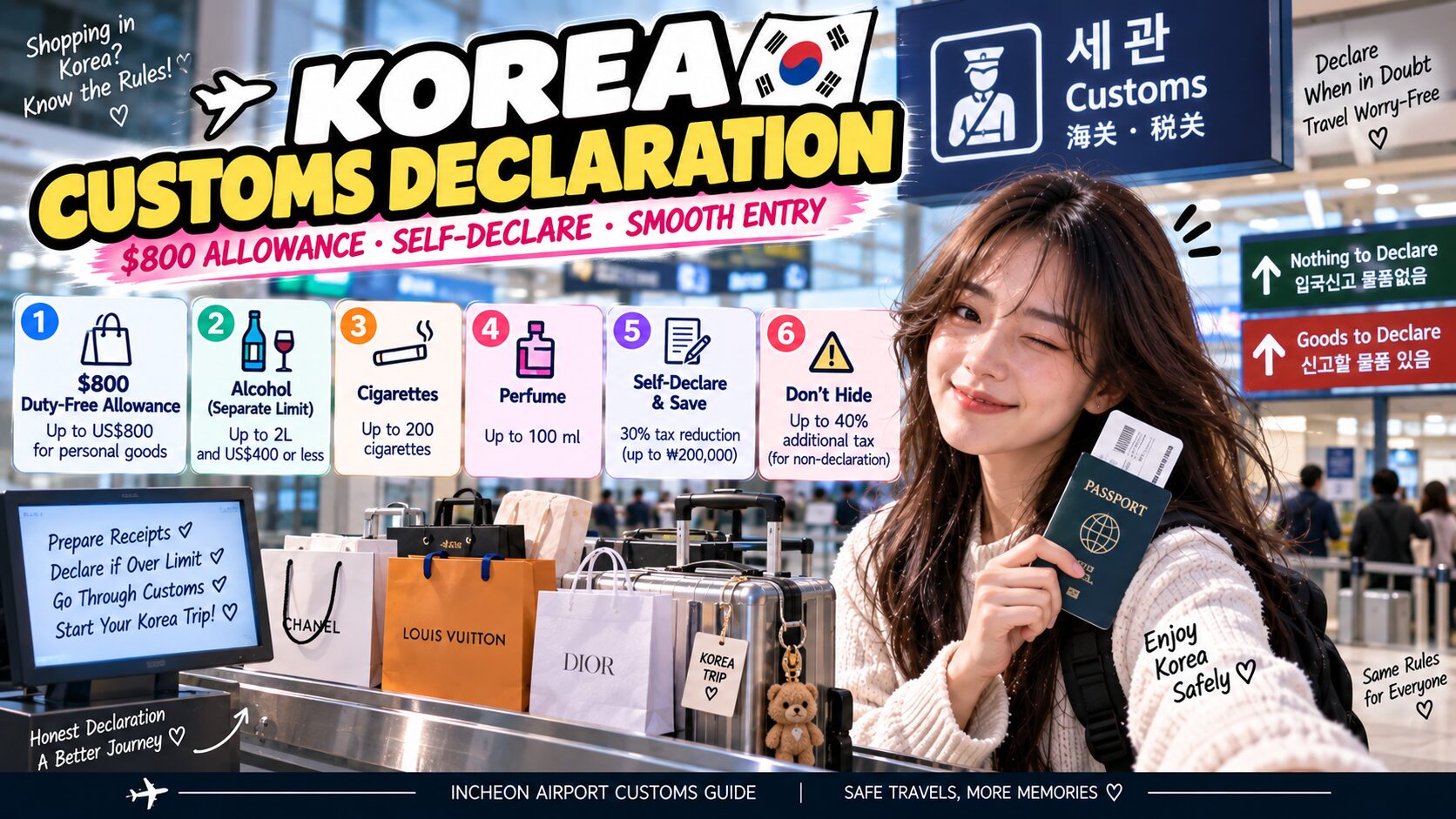
Korea currently provides travelers with a basic duty-free allowance of up to US$800 for eligible personal goods. Certain alcohol, tobacco and perfume allowances are handled separately.
If you go over the allowance, don’t panic.
Going over the limit isn’t automatically a serious problem.
The important thing is to declare the goods properly when you arrive.
1. Korea’s Basic Duty-Free Allowance Is US$800
For ordinary traveler belongings and purchases brought into Korea, the current basic allowance is:
Up to US$800
in total taxable value.
This can include goods purchased overseas and, where applicable, goods purchased from Korean duty-free stores and brought back into Korea. Incheon Airport Customs specifically states that domestic duty-free purchases, including arrival-duty-free purchases, are included when calculating the allowance.
If your eligible general purchases total:
US$650 → normally within the allowance
If they total:
US$1,100 → the amount exceeding the basic allowance may be subject to tax
The exact customs calculation can depend on the type of goods.
2. Alcohol, Cigarettes and Perfume Have Separate Allowances
These categories have separate allowances from the basic US$800 limit.
Current Korea Customs Service limits include:
Alcohol
Up to 2 liters total and a combined value of US$400 or less
Filtered cigarettes
Up to 200 cigarettes
E-cigarette nicotine liquid
Up to 20 ml, where the nicotine concentration is below 1%
Perfume
Up to 100 ml.
Travelers under 19 do not receive the liquor and cigarette exemptions.
Don’t simply add these allowances to your general shopping without checking the category rules.
3. Duty-Free Shopping Does Not Mean Unlimited Import
This is one of the biggest misunderstandings.
Buying something from a duty-free store does not mean you can automatically bring unlimited duty-free products into Korea.
Customs looks at the goods you’re actually bringing into the country.
Korea Customs Service explains that goods purchased overseas and goods purchased at duty-free stores can be combined when determining whether your allowance has been exceeded.
So buying a luxury bag at a duty-free shop doesn’t make it invisible to Korean customs.
4. When Do You Need to Declare?
You should declare if you are carrying goods that exceed your applicable tax-exemption allowance or other goods that legally require declaration.
For this article, the simplest example is:
Shopping over the allowance → declare it
Travelers with declarable goods should complete a declaration and use the Goods to Declare customs channel when arriving.
If you have nothing that requires declaration, Korea no longer generally requires travelers to submit the old paper declaration simply for having nothing to report. The Korea Customs Service removed that requirement in 2023.
5. Voluntary Declaration Can Reduce Your Customs Duty
This is the most important part if you’ve exceeded the limit.
Korean customs encourages travelers to declare honestly.
When eligible taxable traveler goods are voluntarily declared, Korea currently provides a:
30% reduction in customs duty
with the Incheon Airport Customs guidance listing a maximum reduction of ₩200,000.
So hiding the purchase usually makes much less sense than simply declaring it.
6. What Happens If You Don’t Declare?
This is where things become expensive.
If you should have declared taxable goods but customs finds them after you failed to report them, Korea Customs Service says an additional:
40% tax
can be imposed.
Repeated failure to declare can result in an additional:
60%
under the applicable repeat-violation rules.
Incheon Airport Customs specifically notes the higher rate for repeated failures within two years and warns that serious violations can also involve enforcement measures such as confiscation or penalties.
The practical rule is easy:
If you’re unsure whether something needs to be declared, ask customs rather than hiding it.
7. How to Make a Korea Customs Declaration
The Korea customs declaration procedure is fairly straightforward.
After landing:
1. Complete immigration
↓
2. Collect your checked baggage
↓
3. Complete your customs declaration
↓
4. Follow the Goods to Declare channel
↓
5. Show your goods and supporting information if requested
↓
6. Customs calculates applicable tax
↓
7. Pay the tax
↓
8. Complete customs clearance
Incheon Customs states that officers may inspect baggage, including through X-ray screening and physical inspection when necessary.
8. You Can Use Mobile Customs Declaration
You don’t necessarily need to depend on a paper form.
Incheon International Airport currently allows travelers with declarable goods to use the Traveler Customs Declaration mobile app or web service. The Korean airport guidance also states that the system can support tax payment after submission.
This can make the arrival process easier, especially if you already know before landing that you’ve exceeded your allowance.
9. Keep Your Receipts
If you’re bringing expensive purchases into Korea, don’t throw away your receipts before customs.
Keep:
Store receipts
Duty-free receipts
Online purchase confirmation
Credit-card transaction details
Customs needs to determine the value of the goods.
Incheon Airport says that when a traveler voluntarily declares a value, that declared amount can generally be accepted unless it appears unusually low.
Having proof of purchase makes the process much simpler.
10. Example: You Bought US$1,300 of Shopping
Imagine you enter Korea with:
Clothing — US$500
Bag — US$500
Shoes — US$300
Total:
US$1,300
The basic allowance is:
US$800
The taxable calculation generally focuses on the amount and goods exceeding the applicable exemption, subject to how customs applies the relevant tariff rules. Korea Customs Service explicitly states that goods above the exemption allowance are taxable.
Don’t try to calculate the final tax solely by multiplying the excess by one universal percentage.
Different categories can have different tax treatment.
Let customs calculate the actual amount.
11. Example: Alcohol
Suppose you bring alcohol whose combined quantity or value exceeds Korea’s separate allowance.
The current separate exemption requires alcohol to remain within both:
2 liters total
and
US$400 total value.
If your purchase exceeds those limits, declare it.
Don’t assume that the basic US$800 shopping allowance automatically gives you another US$800 worth of alcohol.
The alcohol rules are separate.
12. Arrival Duty-Free Purchases Also Matter
Incheon Airport has arrival duty-free shops.
But buying something after landing and before customs does not mean it can’t affect your allowance.
Korea Customs Service says arrival-duty-free purchases are combined with overseas purchases for customs-clearance purposes.
For example, if you already bought a lot overseas, buying more at the arrivals duty-free store can affect what is taxable.
Check your total before shopping simply because the store says “Duty Free.”
13. Don’t Split One Person’s Purchases Artificially
If one traveler owns an expensive item, don’t assume another person’s unused allowance can automatically erase the tax.
Customs allowance rules apply to travelers and the goods they are actually carrying or importing.
Keep receipts and ownership straightforward.
Trying to disguise who owns expensive goods can turn a simple tax issue into a much more uncomfortable customs inspection.
14. Used Personal Items Are Different from New Shopping
Your normal travel belongings are not treated exactly like a pile of newly purchased merchandise.
Clothes you’re wearing, your normal phone and personal belongings reasonably necessary for travel are generally treated as traveler effects.
Korea Customs Service recognizes ordinary personal effects and items reasonably considered traveler belongings separately in its duty-free guidance.
That doesn’t mean removing the box from a new US$5,000 purchase magically makes it a tax-free “used personal item.”
Customs can look at price, quantity, use and other circumstances.
15. Agricultural and Food Products Have Additional Rules
Duty-free value isn’t the only consideration.
Agricultural, livestock, fishery and other food products may also have quarantine requirements and separate quantity limits.
Korea Customs Service’s current traveler allowance generally limits eligible agricultural/livestock/fishery goods to up to 5 kg per item, 40 kg total, and ₩100,000 total overseas purchase value, subject to passing quarantine inspection.
If you’re carrying meat, plants, seeds or agricultural products, don’t treat them like ordinary souvenirs.
16. Restricted Goods Must Be Declared Even If They’re Cheap
A low price does not automatically make an item legal to bring into Korea.
Restricted or prohibited categories can include items subject to:
- Quarantine
- Medication controls
- Weapons regulations
- Narcotics laws
- Wildlife rules
- Intellectual-property restrictions
Customs clearance rules still apply regardless of whether the item’s price is below US$800.
So don’t confuse:
Duty-free allowance
with
permission to import.
They are completely different questions.
17. Goods to Declare vs Nothing to Declare
At the customs area, the basic logic is:
Nothing declarable
→ Follow the Nothing to Declare route.
Goods exceeding the allowance or otherwise requiring declaration
→ Use Goods to Declare.
Current Incheon Airport instructions specifically tell travelers with declarable items to complete the declaration and use the Goods to Declare lane.
When in doubt, declaration is usually the safer side of the decision.
18. Voluntary Declaration Usually Makes Customs Easier
Declaring goods doesn’t automatically mean you’ll spend hours being interrogated.
Incheon Airport explains that voluntarily declared goods can be processed quickly when the travel purpose, quantity, price and circumstances do not raise particular concerns.
Officials may also accept the declared purchase price unless it appears abnormally low.
So walking into the declaration lane with:
the item
the receipt
and
an accurate declaration
is usually much easier than trying to hide a purchase and getting stopped.
19. Can You Pay Customs Tax Later?
In certain cases, yes.
Incheon Airport Customs guidance says travelers may ask a customs officer about deferred tax payment, and that it may be permitted when the traveler’s identity and circumstances are considered reliable.
But don’t plan your trip assuming delayed payment will always be approved.
Treat it as something customs may allow—not an automatic right.
20. Simple Customs Checklist Before Landing
Before arriving in Korea:
✓ Add up your overseas purchases
✓ Include relevant duty-free purchases
✓ Separate alcohol, tobacco and perfume
✓ Keep receipts
✓ Check restricted goods
If you’re over the limit:
✓ Declare voluntarily
✓ Use the mobile declaration system or declaration form
✓ Follow Goods to Declare
✓ Show receipts when requested
✓ Pay the assessed tax
That’s much easier than worrying about whether customs will stop you.
FAQ
What is Korea’s duty-free allowance?
The current basic traveler allowance is up to US$800 for eligible general goods.
Is alcohol included in the US$800?
Alcohol has a separate exemption of up to 2 liters with a combined value of US$400 or less.
What is the perfume allowance?
The current main Korea Customs Service guidance lists 100 ml.
What happens if I voluntarily declare excess goods?
Eligible travelers can receive a 30% reduction in customs duty, with Incheon customs guidance listing the reduction cap at ₩200,000.
What happens if I don’t declare?
Failure to voluntarily declare can result in an additional 40% tax, with higher additional taxation for repeat violations.
Can I declare on my phone?
Yes. Incheon Airport supports the Traveler Customs Declaration app/web service for mobile declarations.
Do I need to declare if I have nothing taxable?
Travelers without declarable goods generally no longer need to submit the old paper traveler declaration merely to state that they have nothing to declare.
Final Thoughts
The Korea customs declaration system is much less intimidating once you know the basic rule.
Korea gives travelers a US$800 general duty-free allowance, with separate exemptions for certain alcohol, tobacco and perfume.
If you go over the limit, declare it.
Voluntary declaration can reduce the customs duty you owe, while failing to declare can result in substantial additional tax.
Keep your receipts, calculate your purchases before landing and use the Goods to Declare lane when necessary.
Paying the correct tax may be mildly annoying.
Trying to hide an expensive purchase from customs can become much more annoying.
Related Articles
MY NOTE