
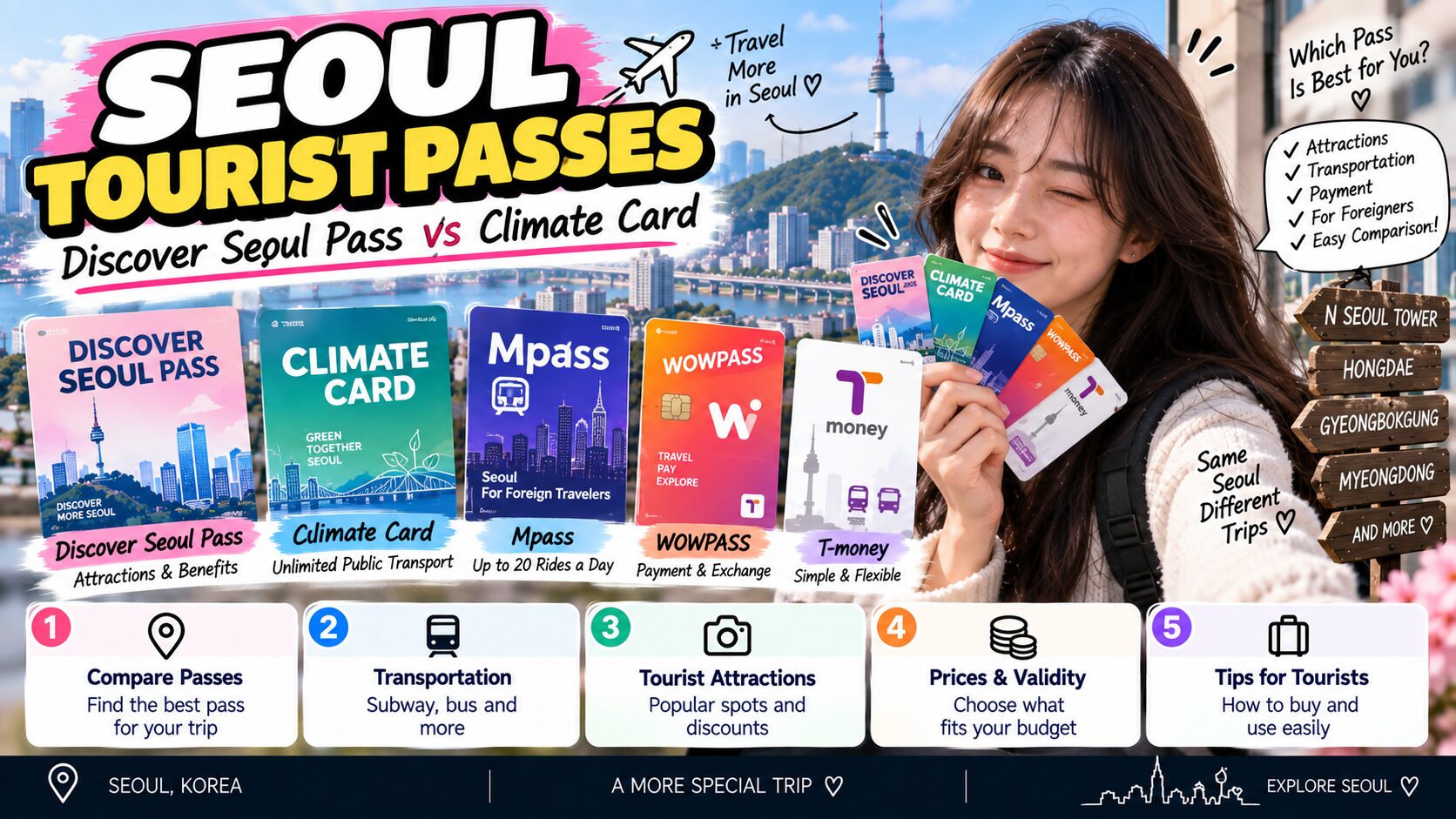
Seoul Tourist Passes: Discover Seoul Pass vs Climate Card
Choosing between Seoul tourist passes can be confusing because several cards look similar but actually serve completely different purposes.
Some give you unlimited public transportation.
Others focus on attractions.
And cards such as WOWPASS are mainly designed for payments and currency exchange rather than unlimited sightseeing.
For most foreign travelers, the main options worth comparing are:
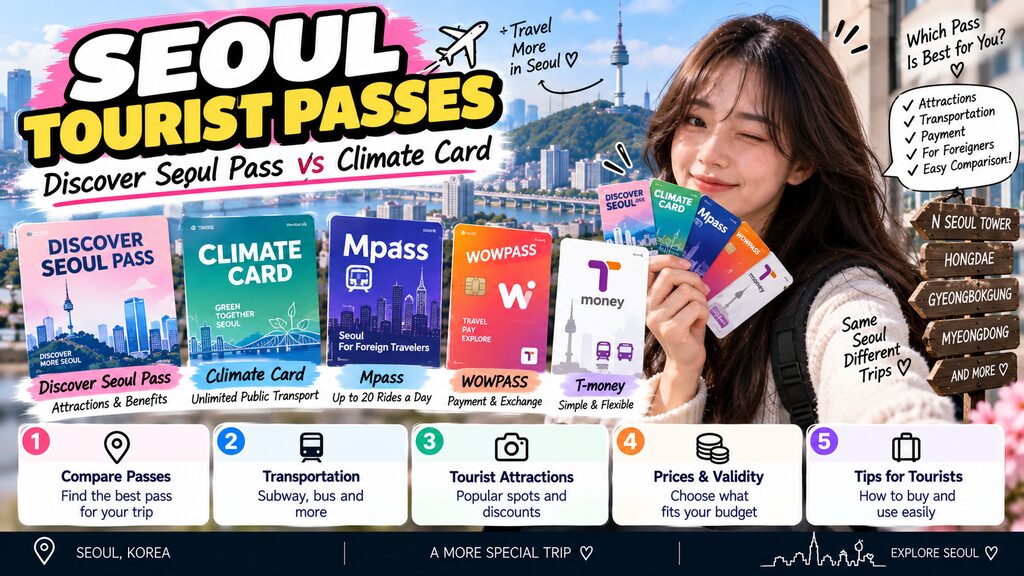
Discover Seoul Pass
Climate Card Short-Term Pass
Mpass
WOWPASS
T-money
Here’s how they differ and which one I’d choose for different types of Seoul trips.
Quick Comparison
| Pass | Best For | Main Benefit | Typical Cost |
|---|---|---|---|
| Discover Seoul Pass | Heavy sightseeing | Attractions + tourist benefits | ₩49,000–₩130,000 |
| Climate Card | Heavy public transit | Unlimited eligible Seoul transit | ₩5,000–₩20,000 + card |
| Mpass | Foreign tourists using transit heavily | Up to 20 rides/day | ₩15,000–₩64,500 |
| WOWPASS | Payment + exchange | Payment, transport & currency exchange | Card fee + loaded balance |
| T-money | Simple everyday travel | Pay only for rides used | Card fee + fares |
The best card depends much more on your itinerary than on which one has the longest benefit list.
1. Discover Seoul Pass — Best for Attractions
The Discover Seoul Pass is the most tourism-focused option.
Current official options include:
72-Hour Pass — ₩90,000
120-Hour Pass — ₩130,000
Pick 3 Basic — ₩49,000
Pick 3 Theme Park — ₩70,000
The pass currently covers more than 70 attractions and also provides over 120 discount benefits.
This makes it particularly useful if your itinerary includes several paid attractions.
Possible benefits include attractions such as:
- Lotte World
- N Seoul Tower
- COEX Aquarium
- Han River cruises
- Hanbok experiences
- Selected airport transportation
The exact participating facilities can change, so check the official attraction list immediately before purchasing.
2. Discover Seoul Pass Is Not Unlimited Subway Travel
This is probably the most important thing to understand.
A physical Discover Seoul Pass can function as a transportation card, but normal subway and bus rides are not automatically unlimited.
You need to load money onto the transit-card function and then pay the normal fare when tapping on public transportation.
So:
Discover Seoul Pass → saves money on attractions
Climate Card → saves money on frequent Seoul transportation
They’re solving different problems.
This is why some travelers can actually benefit from using both.
3. Discover Seoul Pass Also Includes Extra Tourist Benefits
The current Discover Seoul Pass provides a 5-day eSIM benefit along with other tourist discounts and services.
Certain passes also provide airport transportation benefits such as AREX or K-Limousine services.
One useful detail: issuing the AREX benefit can activate the timed Discover Seoul Pass, so don’t redeem it unnecessarily early.
Using the eSIM itself does not activate the sightseeing pass period.
That’s useful if you install your eSIM as soon as you arrive but don’t plan to start sightseeing until the following morning.
4. Climate Card — Best for Unlimited Seoul Transportation
If your main goal is getting around cheaply, the Climate Card Short-Term Pass is much simpler.
Current short-term prices are:
1 day — ₩5,000
2 days — ₩8,000
3 days — ₩10,000
5 days — ₩15,000
7 days — ₩20,000
A physical card currently costs an additional ₩3,000.
During the pass period, you can use eligible Seoul buses and subway services without paying for every individual trip.
For tourists taking several subway or bus rides every day, this can become excellent value.
5. What Does the Climate Card Cover?
The short-term Climate Card covers eligible Seoul subway lines and Seoul-licensed buses, including night buses.
However, it does not cover every rail service in the Seoul metropolitan area.
Services such as:
Sinbundang Line
and
GTX
are excluded.
Another major 2026 change is important.
From October 1, 2026, the 30-day Climate Card products are being discontinued, while the short-term 1-, 2-, 3-, 5- and 7-day tourist passes remain available.
So for international tourists, the short-term version is the one that matters anyway.
6. Don’t Activate the Climate Card Too Early
Unlike an attraction pass that can begin when you first visit an attraction, the Climate Card short-term period starts from the day you load the pass.
For example:
If you load a 3-day pass on Monday, your valid period is based on Monday through Wednesday—not three separate 24-hour periods from the exact charging time.
So don’t load it on Sunday night just because you happen to pass a ticket machine if your sightseeing starts Monday.
Activate it when you actually need it.
7. Discover Seoul Pass vs Climate Card
This is the comparison most travelers actually need.
| Discover Seoul Pass | Climate Card | |
|---|---|---|
| Main purpose | Attractions | Transportation |
| Unlimited subway | No | Yes, eligible routes |
| Bus travel | Pay using topped-up transit function | Eligible buses unlimited |
| Paid attractions | Many included | No |
| eSIM | Included benefit | No |
| Airport benefits | Selected benefits available | Limited / not main purpose |
| Best traveler | Heavy sightseeing | Heavy subway/bus user |
If you’re spending three days visiting expensive attractions, the Discover Seoul Pass can make sense.
If you’re spending three days walking around:
Hongdae
Seongsu
Myeongdong
Gyeongbokgung
Gangnam
and mainly need transportation, Climate Card is probably the better purchase.
8. Mpass — Foreign Tourist Transportation Pass
Mpass is another option specifically designed for foreign travelers.
It allows up to 20 eligible public transportation rides per day on services including metropolitan subway lines, Seoul buses and AREX all-stop services, excluding the AREX Express Train.
Current prices are:
1 day — ₩15,000
2 days — ₩23,000
3 days — ₩30,500
5 days — ₩47,500
7 days — ₩64,500
On price alone, Climate Card is substantially cheaper for many Seoul-only tourists.
So why would anyone use Mpass?
Its service area and transport rules differ, and it includes some transportation outside the Climate Card’s narrower Seoul-focused system.
Still, for the typical tourist staying entirely inside Seoul, I’d compare Climate Card first.
9. WOWPASS — Best for Payment and Currency Exchange
WOWPASS serves another completely different purpose.
It is designed specifically for international visitors and combines:
Prepaid shopping payment
Foreign currency exchange
Transportation-card functions
into one physical card.
You can load funds through supported foreign currencies, international cards and e-wallets.
The card can then be used for payments at many Korean stores as well as buses, subways and taxis.
But remember:
WOWPASS is not an unlimited transportation pass.
You still fund and use the transportation function.
Its strength is convenience, especially for visitors who want one travel-focused card for both spending and transit.
10. T-Money — Still the Simplest Option
Sometimes the simplest option is the best one.
T-money is a standard reloadable transportation card accepted across a huge range of Korean public transportation.
Typical cards cost around:
₩3,000–₩5,000
before adding transportation balance.
Then you simply pay for the journeys you actually take.
T-money makes sense if:
- You aren’t using public transportation constantly
- You’re traveling outside Seoul
- You don’t want to calculate pass value
- You want maximum flexibility
There’s no need to force yourself into a tourist pass just because you’re a tourist.
11. Which Pass Is Best for a 3-Day Seoul Trip?
Here’s how I’d choose.
Lots of expensive attractions
→ Discover Seoul Pass
For example:
Lotte World + N Seoul Tower + aquarium + cruise + hanbok experience.
Lots of subway and bus travel
→ Climate Card 3-Day Pass
Current price: ₩10,000 plus the physical card cost.
Only a few rides each day
→ T-money
Pay-as-you-go may cost less and requires less planning.
Want easier Korean payments and currency exchange
→ WOWPASS
Need a foreigner-specific transit product with broader eligible routes
→ Compare Mpass.
12. Can You Use Discover Seoul Pass and Climate Card Together?
Yes, and for an attraction-heavy trip this can actually be a strong combination.
Think of it like this:
Discover Seoul Pass
→ attractions
Climate Card
→ subway + bus
For example, during a busy three-day sightseeing itinerary you could use Discover Seoul Pass for major paid attractions while using a 3-day Climate Card for moving between them.
The downside is the upfront cost.
So calculate whether your planned attraction admissions actually justify buying Discover Seoul Pass first.
13. How to Know If Discover Seoul Pass Is Worth It
Don’t calculate value based on 70+ attractions.
You’re not visiting 70 attractions.
Write down the attractions you realistically plan to visit.
For example:
Lotte World
N Seoul Tower
COEX Aquarium
Han River Cruise
Then compare their normal admission costs with the pass price.
The official Discover Seoul Pass currently gives an example of a 72-hour itinerary with individual benefits totaling around ₩294,400 compared with the ₩90,000 pass price—but that’s only valuable if you actually want those included experiences.
Unused attractions aren’t savings.
14. How to Know If Climate Card Is Worth It
This calculation is even easier.
Ask:
How many eligible subway and bus rides will I take?
If you’re taking public transport repeatedly throughout each day, a short-term Climate Card quickly becomes attractive.
If you’re staying around Myeongdong and walking almost everywhere, buying an unlimited pass may be unnecessary.
For a one-day itinerary with only two subway journeys, I’d just use T-money.
For three days of constant neighborhood hopping, I’d strongly consider Climate Card.
15. Best Pass by Traveler Type
First-time tourist visiting major paid attractions
→ Discover Seoul Pass
Budget traveler using Seoul transit constantly
→ Climate Card
Traveler visiting several Korean cities
→ T-money
Traveler worried about payment and currency exchange
→ WOWPASS
Foreigner needing up to 20 transit rides per day with Mpass-compatible routes
→ Mpass
Traveler doing both attractions and lots of transit
→ Discover Seoul Pass + Climate Card
That’s the easiest way to think about Seoul tourist passes.
16. One Important Mistake to Avoid
Don’t buy all of these cards.
You don’t need:
Discover Seoul Pass + Climate Card + Mpass + WOWPASS + T-money
just because you’re visiting Korea.
You’ll end up carrying five cards and saving nothing.
Choose based on your real itinerary.
For most visitors, I would use one of these combinations:
Simple trip
T-money only
Transport-heavy Seoul trip
Climate Card
Attraction-heavy Seoul trip
Discover Seoul Pass + transportation card
Shopping/payment-focused trip
WOWPASS
Keep it simple.
FAQ
Is Discover Seoul Pass an unlimited transportation card?
No. The physical card can function as a reloadable transit card, but normal subway and bus trips require a topped-up balance.
Is the Climate Card available to tourists?
Yes. Seoul offers 1-, 2-, 3-, 5- and 7-day short-term passes suitable for visitors.
Which is cheaper, Climate Card or Mpass?
For comparable short stays, Climate Card currently has substantially lower prices, although their eligible transportation networks and rules are not identical.
Is WOWPASS unlimited transportation?
No. It combines payment, currency exchange and a transportation-card function, but it isn’t an unlimited transit pass.
Can I use the Climate Card throughout Korea?
No. It is primarily a Seoul transportation product with a defined service area. T-money is much more suitable when traveling around multiple Korean cities.
Which pass is best for first-time tourists?
If you’re visiting several paid attractions, start by checking Discover Seoul Pass. If your itinerary is mostly neighborhoods, cafés, shopping and free attractions, Climate Card or T-money will usually make more sense.
Final Thoughts
There is no single winner among Seoul tourist passes.
The Discover Seoul Pass is best viewed as an attraction pass with extra tourist benefits.
The Climate Card is primarily an unlimited Seoul transportation pass.
Mpass offers another foreigner-focused transportation option, while WOWPASS focuses on payments and currency exchange, and T-money remains the easiest pay-as-you-go choice.
Don’t ask:
“Which card has the most benefits?”
Ask:
“What am I actually doing in Seoul?”
Once you know that, choosing the right pass becomes much easier.
Related Articles
MY NOTE