
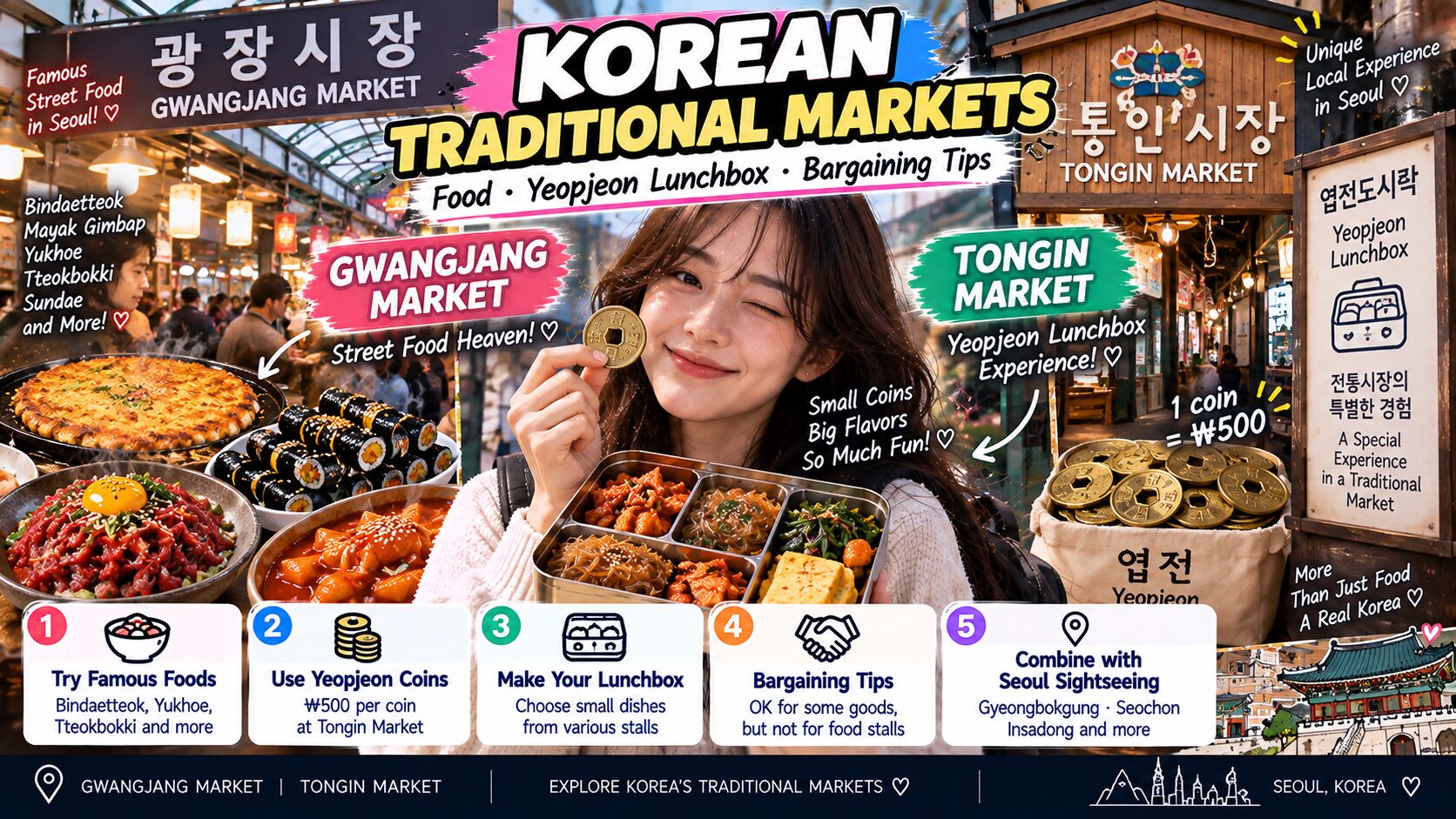
Korean Traditional Market Guide: Yeopjeon Lunchbox & Bargaining Tips
This Korean traditional market guide is for travelers who want to do more than simply walk through a market and take photos.
Seoul’s Gwangjang Market and Tongin Market offer very different experiences.
Gwangjang is famous for busy food stalls, bindaetteok, gimbap and yukhoe, while Tongin Market is best known for its unique Yeopjeon Lunchbox experience.
And no—the famous brass-coin lunchbox isn’t at Gwangjang Market.
It’s at Tongin Market.
Here’s how both markets work and what foreign travelers should know about ordering, paying and bargaining.
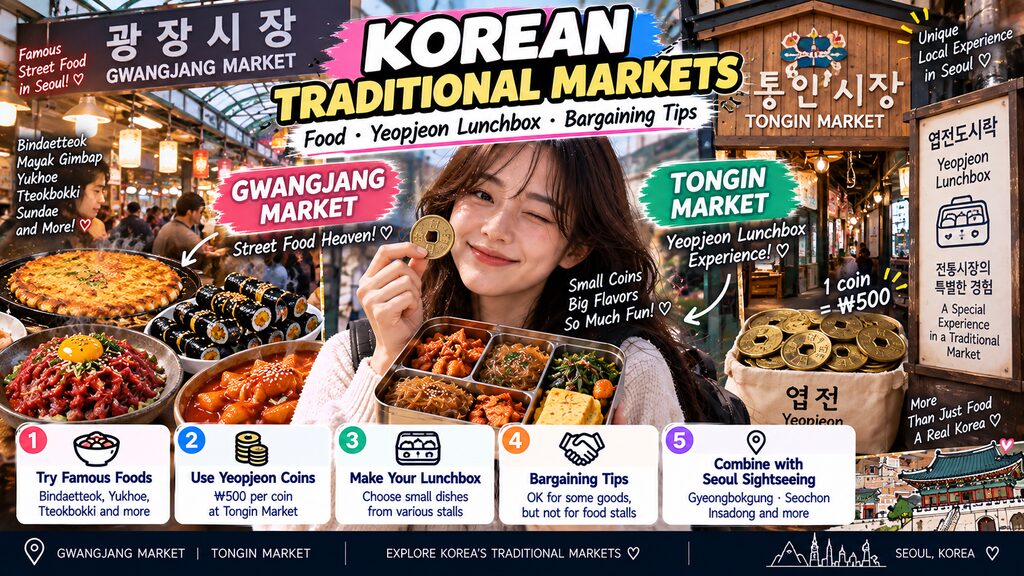
Gwangjang Market vs Tongin Market
The easiest way to choose is:
Gwangjang Market
Best for street food, lively crowds and a famous traditional-market atmosphere.
Tongin Market
Best for the Yeopjeon Lunchbox, smaller portions and combining the market with Seochon and Gyeongbokgung.
If you have enough time, they’re different enough to visit both.
What Is the Tongin Market Yeopjeon Lunchbox?
Yeopjeon means an old-style Korean brass coin.
At Tongin Market, visitors can exchange normal money for special Yeopjeon tokens and use them to buy small portions of food from participating stalls.
After filling your tray, you return to the Lunchbox Café and eat everything together.
The program is still operating in 2026, and Seoul’s official tourism guide continues to list the Dosirak Café as one of Tongin Market’s main attractions.
It’s basically:
Exchange money
↓
Receive Yeopjeon
↓
Get a lunchbox tray
↓
Walk through the market
↓
Choose different foods
↓
Pay participating stalls with coins
↓
Return to the café and eat
Very easy.
How Much Is One Yeopjeon?
Current official tourism guidance values each Yeopjeon token at:
₩500 per coin
The guide says coins can be purchased from the Lunchbox Café, with additional purchases possible, and unused coins can be refunded. Card, cash and bank-transfer payment are listed for purchasing the tokens.
Older Seoul guidance often recommended starting with:
10 coins = ₩5,000
per person.
For today’s prices, however, I wouldn’t assume ₩5,000 will always make a huge lunch.
Start with a reasonable amount and buy more if necessary.
Where Do You Buy the Coins?
Head to the Dosirak Café / Lunchbox Café inside Tongin Market’s Customer Service Center.
Current tourism information places the café on the second floor.
Don’t simply walk into any shop carrying your coins.
Only participating stalls accept Yeopjeon.
Look for participating-store signs or use the current market QR map provided around the Lunchbox Café. Official guidance also says the QR service includes menu translation in English, Japanese, Simplified Chinese and Traditional Chinese.
That’s extremely useful for first-time foreign visitors.
What Should You Put in Your Lunchbox?
Tongin Market is particularly famous for:
Gireum Tteokbokki
Oil-fried rice cakes with a very different texture from saucy tteokbokki.
Gimbap
Easy to share and doesn’t take much tray space.
Japchae
Glass noodles with vegetables.
Tteokgalbi
Grilled meat patties.
Dumplings
Good if you want something more filling.
Recent Visit Seoul coverage also highlights foods including oil tteokbokki, kimchi dumplings, gimbap, gujeolpan and lotus-leaf rice among items visitors can combine.
The whole point isn’t to buy five portions of the same thing.
Try several small dishes.
When Should You Visit Tongin Market?
The general market is listed as operating roughly:
07:00–21:00
although individual shop hours vary.
VISITKOREA currently lists the Dosirak Café around:
11:00–15:00.
Seoul’s tourism pages also show extended weekend hours on some listings, while closure information has varied between official pages as schedules have been updated.
So for the Yeopjeon Lunchbox, I’d aim for:
11:30–14:00
and check the current official listing on the day you visit.
Don’t show up at 7 PM expecting the lunchbox program simply because the overall market is still open.
How to Get to Tongin Market
The easiest station is:
Gyeongbokgung Station — Line 3
Use Exit 2 and walk roughly 500 meters toward the market.
That makes Tongin extremely easy to combine with:
Gyeongbokgung Palace
↓
Seochon
↓
Tongin Market
↓
Cheongwadae area or cafés
For a first Seoul trip, that’s a very efficient half-day route.
What Makes Gwangjang Market Different?
Gwangjang Market is much larger and has a completely different energy.
The main attraction for tourists is usually the food section.
Expect dishes such as:
Bindaetteok
Mung-bean pancakes.
Mayak Gimbap
Small gimbap rolls.
Yukhoe
Seasoned raw beef.
Tteokbokki
Spicy rice cakes.
Sundae
Korean blood sausage.
Seoul tourism information currently lists the main market around 09:00–18:00, with its food alley operating later, until around 23:00.
That makes Gwangjang much better than Tongin if you want a market-food experience in the evening.
Does Gwangjang Market Use Yeopjeon?
No.
This is an easy tourist mistake.
The special token-based lunchbox program belongs to:
Tongin Market
not Gwangjang.
At Gwangjang, you normally order directly from individual vendors and pay using their accepted payment method.
So don’t arrive at Gwangjang asking where to exchange money for lunchbox coins.
Can You Bargain at Korean Traditional Markets?
Sometimes—but don’t treat Korea like a country where you’re expected to negotiate every price.
This is probably the most important bargaining rule in this Korean traditional market guide.
Food stalls
Generally, don’t bargain.
If a pancake costs ₩5,000, don’t ask for ₩3,000 because you’re a tourist.
Clearly priced products
Usually pay the displayed price.
Clothing, accessories or miscellaneous goods
At some independent stalls, there may be a little flexibility.
This is especially possible when:
- There’s no clearly displayed price
- You’re buying several items
- The seller voluntarily suggests a discount
But aggressive bargaining isn’t necessary.
How to Bargain Politely
Instead of demanding a lower price, ask gently.
Useful Korean:
조금 할인돼요?
Jogeum harin dwaeyo?
“Is a small discount possible?”
Or if buying several items:
두 개 사면 할인돼요?
Du gae samyeon harin dwaeyo?
“Is there a discount if I buy two?”
If the seller says no, just accept it.
That’s much better than arguing over ₩1,000 for ten minutes.
Don’t Bargain Over Street Food
This deserves its own rule because tourists sometimes misunderstand “traditional market.”
Food stalls usually operate with straightforward listed prices.
You’re buying:
one pancake
one bowl
one serving
not negotiating a wholesale contract.
Pay the price and enjoy the food.
Your bargaining energy is better saved for goods where there genuinely isn’t a clearly fixed price.
Check the Price Before Ordering
This is more useful than bargaining.
Say:
얼마예요?
Eolmayeyo?
“How much is it?”
If language is difficult, show your phone calculator and let the vendor enter the amount.
That prevents misunderstandings before they happen.
Especially check whether a price is:
per piece
per serving
or
per set
before saying yes.
Cash or Card?
Many established market businesses now accept cards.
But carrying some Korean won is still useful for smaller traditional stalls.
For Tongin’s Yeopjeon program, current official tourism guidance specifically lists card, cash and bank transfer as methods for purchasing the market tokens.
For ordinary purchases, I’d carry:
International credit card + ₩10,000 and ₩5,000 notes
You don’t need to walk around with hundreds of thousands of won in cash.
Useful Korean Market Phrases
| Korean | Meaning |
|---|---|
| 이거 주세요 | This one, please |
| 얼마예요? | How much is it? |
| 카드 돼요? | Can I pay by card? |
| 현금만 돼요? | Cash only? |
| 하나 주세요 | One, please |
| 두 개 주세요 | Two, please |
| 조금 할인돼요? | Can you give a small discount? |
| 두 개 사면 할인돼요? | Discount if I buy two? |
| 포장해 주세요 | To go, please |
| 감사합니다 | Thank you |
You really only need:
이거 주세요
얼마예요?
카드 돼요?
for most situations.
Which Market Is Better for Foreign Travelers?
Choose Tongin Market if you want:
- Yeopjeon Lunchbox
- A smaller, easier market
- Seochon sightseeing
- A unique cultural activity
- Gyeongbokgung nearby
Choose Gwangjang Market if you want:
- More street food
- A busier atmosphere
- Evening food options
- Bindaetteok
- Yukhoe
- A larger market experience
Personally, I wouldn’t choose one as “better.”
They’re designed for different experiences.
Easy Traditional Market Day
A nice Seoul itinerary would be:
Morning
Gyeongbokgung Palace
↓
Lunch
Tongin Market Yeopjeon Lunchbox
↓
Afternoon
Seochon cafés
↓
Insadong / Jongno
↓
Evening
Gwangjang Market
You’d experience both markets on the same day without wasting too much time crossing Seoul.
Just don’t try to eat a full meal at every stop ㅋㅋ.
Traditional Market Etiquette
A few simple rules make things smoother:
Don’t block narrow aisles
Markets are working spaces.
Ask before photographing vendors closely
Especially if you’re photographing a person rather than just the stall.
Don’t touch food unnecessarily
Point instead.
Don’t take huge samples without buying
If samples are offered, one is enough.
Don’t force bargaining
A discount is optional, not your right.
Keep your trash with you until you find the proper bin
Basic stuff, but it makes a difference.
FAQ
Where can I try the Yeopjeon Lunchbox in Seoul?
Tongin Market. The Lunchbox Café lets visitors exchange money for Yeopjeon tokens and buy small dishes from participating stalls.
How much is one Yeopjeon?
Current tourism guidance lists one token at ₩500.
Can I use Yeopjeon at every Tongin Market shop?
No. Only participating businesses accept the lunchbox tokens. The current system provides a QR map showing eligible stores.
Can I bargain at Gwangjang Market?
For food, don’t. For some clothing, accessories or unpriced goods, a polite discount request may sometimes be acceptable.
Which market is better for food?
Gwangjang has a much larger and livelier street-food scene. Tongin is better if the Yeopjeon Lunchbox experience itself is your priority.
Final Thoughts
Using a Korean traditional market guide before your first visit can save you from several easy mistakes.
Remember that Tongin Market is where you do the Yeopjeon Lunchbox experience, while Gwangjang Market is better known for its large street-food scene.
At Tongin, exchange money for the brass tokens, choose small dishes from participating stalls and build your own lunch.
At both markets, check prices before buying and don’t assume bargaining is required.
Traditional markets are more enjoyable when you treat them as places to explore, eat and interact with local businesses—not as a competition to see how cheaply you can buy everything.
Related Articles
MY NOTE