
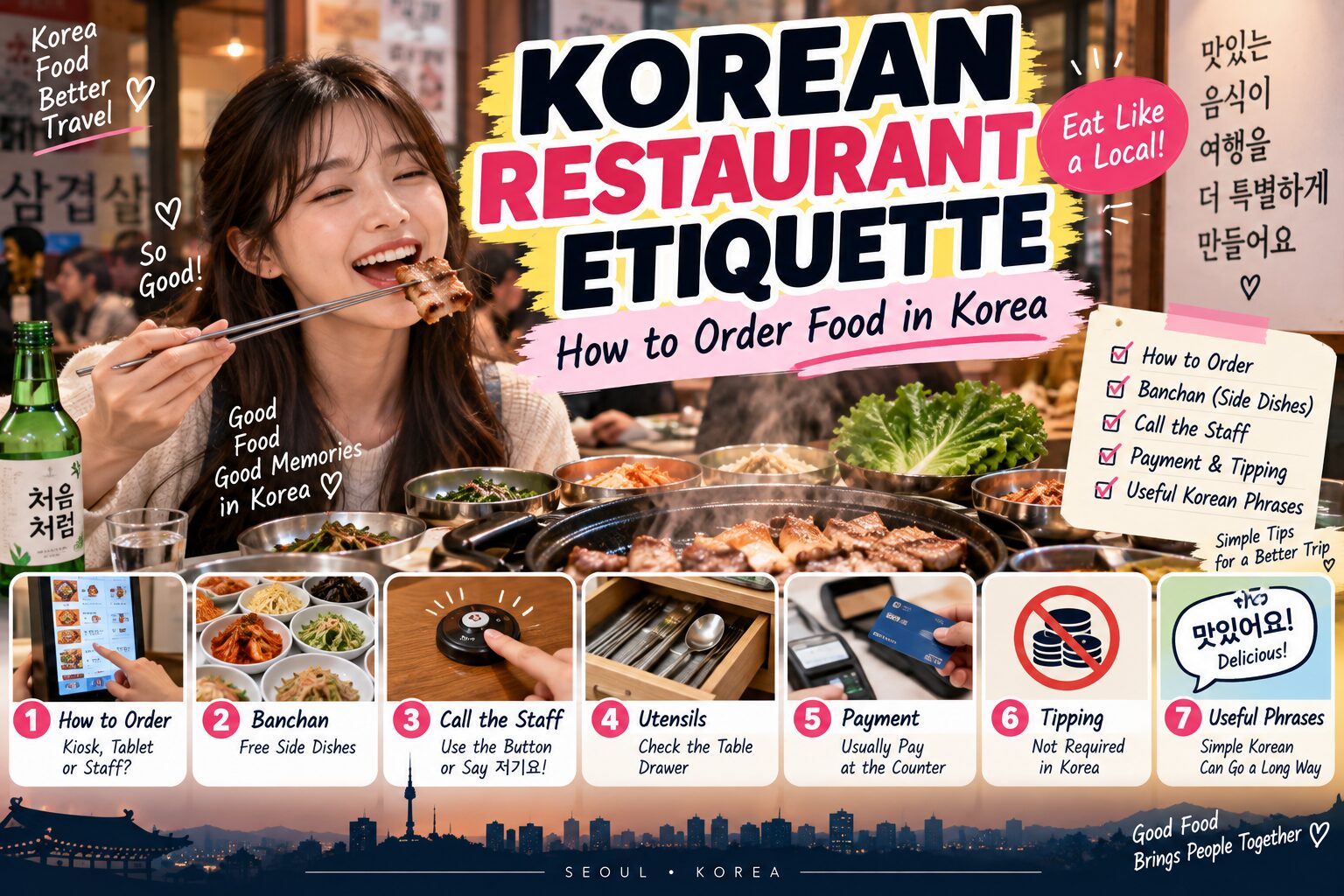
Korean Restaurant Etiquette: How to Order Food in Korea
Understanding Korean restaurant etiquette can make eating in Korea much easier, especially on your first trip.
You may enter a restaurant and wonder why nobody comes to take your order. Water may be self-service, your chopsticks may be hidden inside the table, and the server may expect you to press a button when you need something.
None of this is complicated once you understand how Korean restaurants work.
Here is a practical guide to how to order food in Korea, pay for your meal and avoid the most common mistakes travelers make.
1. First, Check How the Restaurant Takes Orders
There isn’t one ordering system used by every restaurant in Korea.
Depending on the restaurant, you may order:
- Directly from a server
- With a call button
- At the counter
- From a touchscreen kiosk
- Using a tablet at your table
- Through a QR-code menu
Newer restaurants and cafés increasingly use kiosks or tablets, while traditional restaurants may still take orders directly.
Before sitting down and waiting, look around and see what other customers are doing.
That’s often the quickest way to understand the system.
2. Check Whether the Price Is Per Person
This is particularly important at Korean barbecue restaurants.
You may see something like:
삼겹살 1인분 ₩15,000
1인분 means one serving.
Some meat, hot-pot and shared-dish restaurants require a minimum order of two servings, even if only one person is eating. This varies by restaurant and menu.
So if you see a surprisingly low price, don’t automatically assume that’s the total price for the whole table.
Useful words
1인분 — one serving
2인분 — two servings
2인 이상 — two or more people
Solo travelers may find dishes such as bibimbap, gimbap, gukbap and noodles easier to order individually.
3. You Can Order Without Speaking Korean
Don’t avoid a local restaurant just because the menu is in Korean.
One of the easiest ways to order is simply to point at the menu and say:
이거 주세요.
Igeo juseyo.
“This one, please.”
Want two?
이거 두 개 주세요.
Igeo du gae juseyo.
“Two of these, please.”
A translation app such as Papago can also help with menus and follow-up questions.
If a restaurant has pictures on the menu, ordering can be surprisingly easy even without speaking Korean.
4. It’s Normal to Call the Server
This surprises a lot of first-time visitors.
At many Korean restaurants, staff don’t continuously return to the table to ask whether you need anything.
Instead, there may be a small call button on the table.
Press it when you’re ready to order or need something else. Korea’s official tourism guide specifically lists table call bells as a common restaurant feature.
No button?
Say:
저기요!
Jeogiyo!
“Excuse me!”
This is completely normal in a Korean restaurant.
Waiting silently for someone to notice you can sometimes mean waiting much longer than necessary.
5. Water and Side Dishes May Be Self-Service
Another important part of Korean restaurant etiquette is recognizing self-service areas.
You may see:
셀프
This simply means self-service.
Water, cups, utensils and sometimes side dishes may be available at a separate station.
So if nobody brings water to your table, don’t immediately assume the staff forgot.
Check for a self-service area first.
Korea Tourism Organization guidance notes that self-service water and side-dish stations have become increasingly common.
6. What Are All These Free Side Dishes?
Those small dishes that suddenly appear on your table are called:
반찬 — banchan
Depending on the restaurant, you might receive kimchi, pickled vegetables, seasoned sprouts or other side dishes.
In ordinary Korean restaurants, water and standard side dishes are commonly provided without an extra charge, and additional servings are often available. Some restaurants use a self-service refill station.
However, don’t assume every special side dish everywhere has unlimited free refills.
Check the restaurant’s signs or ask if you’re unsure.
And take only as much as you’re actually going to eat.
7. Check the Side of the Table for Chopsticks
Can’t find your spoon or chopsticks?
Look under the edge of the table.
Many Korean restaurant tables have a drawer containing:
- Metal chopsticks
- Spoons
- Napkins
- Sometimes bottle openers
This is another restaurant feature specifically highlighted by Korea Tourism Organization guidance.
You normally don’t need to ask the staff for utensils if they’re already inside the table.
8. Know a Few Basic Korean Table Manners
You don’t need to memorize dozens of traditional rules to eat comfortably in Korea.
But there are a few useful pieces of Korean dining etiquette.
Don’t stick your chopsticks vertically into your rice.
Traditionally, this resembles a ritual associated with offerings for the deceased. Korea.net also advises keeping rice and soup bowls on the table rather than lifting them while eating.
When eating with Korean friends, especially older people, it’s polite to let the eldest person begin first.
For a casual meal between tourists, you don’t need to make every bite into a formal ceremony.
The goal is simply to be respectful.
9. Korean BBQ Has Its Own Rhythm
Korean barbecue can be confusing on your first visit.
You’ll usually have a grill built into or placed on the table.
Depending on the restaurant, staff may:
- Cook the meat for you
- Start cooking it and leave you to finish
- Expect you to grill everything yourself
Watch what the staff does before immediately taking over the grill.
Tongs and kitchen scissors may also be provided for cooking and cutting the meat.
A good practical rule is to avoid using utensils that touched raw meat as your personal eating utensils.
And if a server suddenly starts changing the grill plate, don’t worry—that’s normal service at many barbecue restaurants.
10. Tell the Staff About Food Allergies Clearly
This is one situation where pointing at pictures isn’t enough.
If you have a serious food allergy, prepare a translated Korean message before entering the restaurant.
For example:
저는 땅콩 알레르기가 있습니다.
Jeoneun ttangkong allereugiga itsseumnida.
“I have a peanut allergy.”
Don’t rely only on asking whether a dish “contains nuts” if cross-contact is medically important.
Show a clearly written explanation of your allergy and its severity.
Similarly, remember that:
안 매워요?
“Is it not spicy?”
and
덜 맵게 해 주세요.
“Please make it less spicy.”
do not guarantee every dish can actually be made mild.
Some sauces or dishes are prepared in advance.
11. Don’t Wait for the Check at Your Table
Finished eating?
In many casual Korean restaurants, you simply walk to the cashier near the entrance and pay there.
You may not receive a bill at the table first.
If you’re unsure, say:
계산할게요.
Gyesanhalgeyo.
“I’d like to pay.”
This is another small difference that can confuse travelers who are used to waiting for a server to bring the bill.
12. You Usually Don’t Need to Tip
One of the easiest rules to remember:
Tipping is generally not expected in Korean restaurants.
Korea Tourism Organization guidance explicitly states that tipping is not required or expected.
If your meal costs ₩32,000, you normally just pay ₩32,000.
You don’t need to leave cash on the table or calculate an additional 15–20%.
That’s one part of eating out in Korea that many international travelers find refreshingly simple.
Useful Korean Restaurant Phrases
| Korean | Pronunciation | Meaning |
|---|---|---|
| 저기요 | Jeogiyo | Excuse me |
| 이거 주세요 | Igeo juseyo | This one, please |
| 물 주세요 | Mul juseyo | Water, please |
| 안 매워요? | An maewoyo? | Is it not spicy? |
| 덜 맵게 해 주세요 | Deol maepge hae juseyo | Please make it less spicy |
| 반찬 더 주세요 | Banchan deo juseyo | More side dishes, please |
| 영어 메뉴 있어요? | Yeongeo menyu isseoyo? | Do you have an English menu? |
| 계산할게요 | Gyesanhalgeyo | I’d like to pay |
| 감사합니다 | Gamsahamnida | Thank you |
You don’t need to memorize all of them.
저기요 and 이거 주세요 alone can get you surprisingly far.
Korean Restaurant Etiquette: Quick Checklist
Before your first meal, remember these basics:
Check how ordering works
→ Server, button, kiosk or tablet
Check the number of servings
→ Especially Korean BBQ and shared dishes
Look for 셀프
→ Water and side dishes may be self-service
Check the table drawer
→ Your spoon and chopsticks may already be there
Use the call button or say 저기요
→ Don’t wait forever for the server
Pay at the counter when appropriate
No tip is normally necessary
If you understand those seven things, you’ve already learned most of the practical Korean restaurant etiquette a traveler actually needs.
FAQ
Is it rude to call a waiter in Korea?
No. Using a table call button or saying 저기요 is a normal way to get the staff’s attention at many restaurants.
Are Korean side dishes free?
Standard banchan are commonly included with the meal, and refills are often available. Policies can vary, especially for particular dishes, so follow the restaurant’s signs or ask staff if you’re unsure.
Do tourists need to tip in Korea?
Generally, no. Tipping is not normally expected at Korean restaurants.
Can I eat alone at Korean restaurants?
Yes, but some shared dishes or barbecue menus may have minimum serving requirements. Look for individual meals or restaurants that welcome solo diners.
Can I order food in Korea without speaking Korean?
Yes. Pointing at the menu, using translation apps, ordering kiosks and a few simple Korean phrases make ordering food in Korea much easier.
Final Thoughts
Learning Korean restaurant etiquette isn’t about following a long list of strict cultural rules.
For most travelers, the practical differences matter much more.
Know how to call the staff, check whether water is self-service, understand portions, look for your utensils inside the table and remember that you usually don’t need to tip.
Once you understand how Korean restaurants operate, eating local food becomes much less intimidating—and much more fun.
Related Articles
MY NOTE