
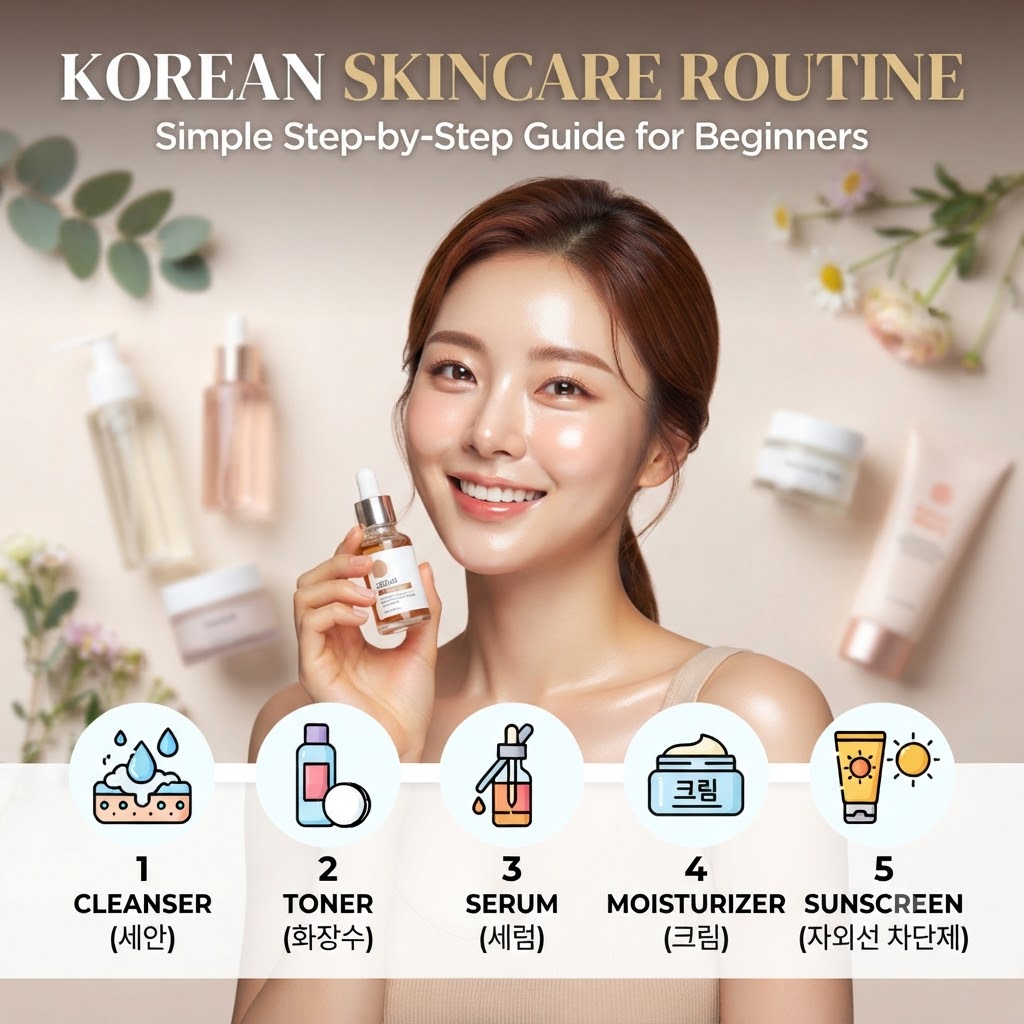
What Is a Korean Skincare Routine?
Korean skincare has become popular around the world for its focus on hydration, gentle care, and maintaining healthy-looking skin over time.
If you are new to K-beauty, however, you may have heard that a Korean skincare routine requires 10 different steps every morning and night.
It doesn’t.
Many people in Korea adjust their routines depending on their skin type, the season, and how their skin feels that day.
Instead of focusing on the number of products, it is more useful to understand what each skincare step does and choose the ones that work for your skin.
Here is a simple Korean skincare routine for beginners.
Step 1: Cleanser
Cleansing is the foundation of almost every skincare routine.
In the morning, some people prefer a gentle facial cleanser, while others simply rinse their face with water depending on their skin type.
At night, cleansing becomes more important because sunscreen, makeup, oil, and dirt have accumulated on the skin throughout the day.
Choose a cleanser that removes impurities without leaving your skin feeling excessively dry or tight.
Step 2: Double Cleansing at Night
Double cleansing is one of the best-known Korean skincare steps.
The idea is simple.
First, use an oil cleanser or cleansing balm to remove makeup and sunscreen.
Then use a water-based facial cleanser to remove remaining dirt, sweat, and impurities.
You don’t necessarily need to double cleanse every time you wash your face. It is particularly useful at night when you have been wearing makeup or water-resistant sunscreen.
Step 3: Toner
Korean toners are often used to add lightweight hydration after cleansing.
Apply a small amount with your hands or a cotton pad and gently pat it into your skin.
Some toners focus mainly on hydration, while others contain ingredients designed for exfoliation or specific skin concerns.
Beginners may find it easier to start with a simple hydrating toner rather than introducing several active ingredients at once.
Step 4: Essence
Essence is one of the products most closely associated with Korean skincare.
It usually has a lightweight texture and is applied after toner.
Essences are generally designed to provide hydration and prepare the skin for the products that follow.
However, essence is optional.
If you prefer a simple skincare routine, you can skip this step.
Step 5: Serum or Ampoule
This is where you can personalize your Korean skincare routine based on your main skin concerns.
Serums and ampoules contain concentrated ingredients designed for different purposes.
Depending on the product, they may focus on hydration, dullness, uneven-looking skin tone, texture, or other concerns.
The important thing is not to use as many serums as possible.
Start with one product that addresses your main concern and see how your skin responds.
Step 6: Sheet Mask
Sheet masks are one of the most recognizable K-beauty products, but you do not need to use one every day.
Many people use them occasionally when they want extra hydration or simply want a relaxing skincare step.
After removing the mask, gently pat the remaining essence into your skin instead of immediately washing it off, unless the product instructions say otherwise.
Think of sheet masks as an optional addition rather than an essential daily step.
Step 7: Eye Cream
Eye cream is another optional step.
The skin around the eyes can feel more delicate or dry, so some people prefer using a product specifically designed for this area.
Apply a small amount gently around the eye area without rubbing aggressively.
If your regular moisturizer already works well around your eyes, you may not necessarily need a separate eye cream.
Step 8: Moisturizer
Moisturizer is one of the most important steps in a Korean skincare routine.
It helps keep the skin hydrated and supports the skin barrier.
The best texture depends on your skin type and the season.
People with oily skin may prefer lightweight gels or lotions, while people with dry skin may prefer richer creams.
Korean skincare routines also commonly change throughout the year. A lightweight moisturizer may feel comfortable during Korea’s humid summer, while a richer cream may be preferred during the dry winter months.
Step 9: Sunscreen
If there is one step you should not overlook in your morning routine, it is sunscreen.
Sunscreen is typically the final skincare step before makeup.
Korean sunscreens are available in many textures, including lightweight lotions, creams, sticks, and essences.
Choose a sunscreen that you are comfortable applying consistently and follow the product directions for application and reapplication.
Do You Really Need a 10-Step Korean Skincare Routine?
No.
The famous “10-step Korean skincare routine” helped introduce K-beauty to international audiences, but Korean skincare does not require everyone to use exactly 10 products.
A basic routine can be much simpler.
Simple Morning Routine
Cleanser → Toner → Serum → Moisturizer → Sunscreen
Simple Night Routine
Oil Cleanser → Facial Cleanser → Toner → Serum → Moisturizer
Additional products such as essences, sheet masks, eye creams, and exfoliating products can be added depending on your preferences and skin needs.
Korean Skincare Tips for Beginners
The biggest mistake beginners can make is buying many new products and using all of them at the same time.
If irritation occurs, it becomes difficult to identify which product caused the problem.
Instead, introduce new products gradually.
Patch testing can also be useful before applying a new product widely, particularly if your skin is sensitive.
Another important point is that expensive products are not automatically better.
Korean beauty stores offer products across a wide range of prices, so beginners can build a routine without purchasing luxury skincare.
Where to Buy Korean Skincare in Korea
If you are visiting South Korea, skincare products are easy to find in major shopping areas.
Olive Young is one of the most recognizable beauty retailers in Korea and carries products from numerous Korean skincare brands.
Areas such as Myeongdong, Hongdae, Gangnam, and Seongsu also have many beauty stores and individual brand shops.
Visitors interested in K-beauty may want to compare prices, promotions, and tax refund eligibility before purchasing several products.
Final Thoughts
A Korean skincare routine does not need to be complicated.
Instead of trying to follow every viral K-beauty trend, start with the basics:
Cleanse → Hydrate → Moisturize → Protect
Once you understand how your skin responds, you can gradually add toners, essences, serums, masks, or other products that fit your needs.
The goal of Korean skincare is not to use the largest number of products. A consistent routine that works well for your own skin is much more important.