
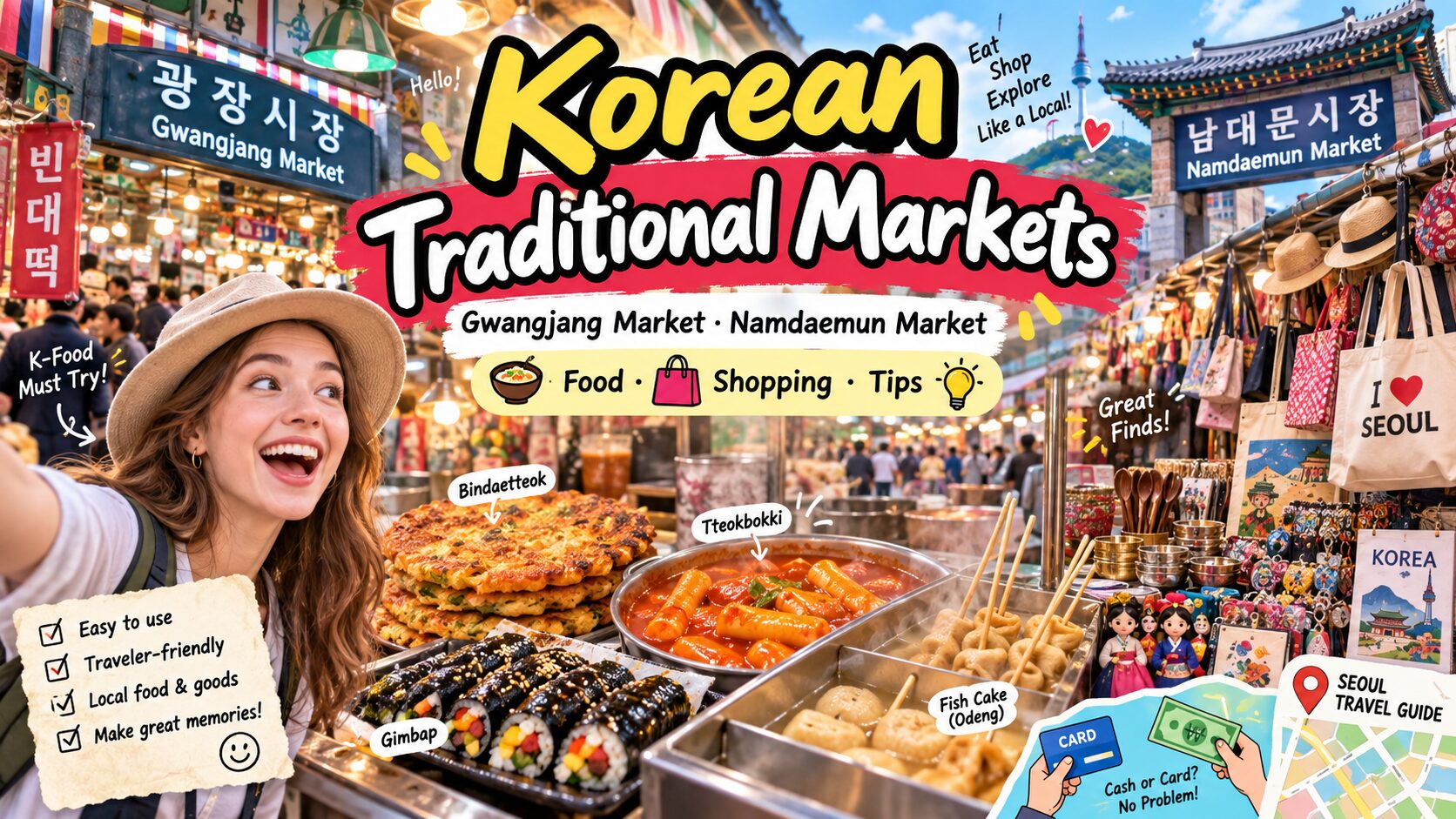
Korean Traditional Markets: Gwangjang & Namdaemun Guide 1
Visiting Korean traditional markets is one of the easiest ways to experience a side of Seoul that feels completely different from department stores and modern shopping malls.
But your first visit can be confusing.
Where do you order? Do you sit anywhere? Can you pay by card? Should you bargain? And what exactly should you eat?
For first-time visitors, Gwangjang Market and Namdaemun Market are two of the easiest places to start.
They are both famous, centrally located and foreigner-friendly—but they offer very different experiences.

Gwangjang Market vs Namdaemun Market
The simplest difference is this:
Gwangjang Market
Best for:
- Korean street food
- Bindaetteok
- Gimbap
- Yukhoe
- Traditional market atmosphere
- Vintage clothing and hanbok
Namdaemun Market
Best for:
- Shopping
- Souvenirs
- Clothes
- Kitchenware
- Accessories
- Kalguksu
- Braised hairtail
If food is your main goal, I’d start with Gwangjang.
If you want to actually browse and buy things, Namdaemun is much more interesting.
1. Gwangjang Market — Best for Korean Street Food
Gwangjang Market is one of Seoul’s most famous traditional markets and especially popular with international travelers.
The official Seoul tourism guide highlights foods including bindaetteok, mayak gimbap, sundae and yukhoe. You’ll also find tteokbokki, fish cake and assorted Korean pancakes throughout the food area.
Getting There
Subway: Line 1
Station: Jongno 5-ga
Exit: 8
The market is only a short walk from the station.
Opening Hours
The general market currently operates around:
09:00–18:00
while the food alley runs approximately:
09:00–23:00
Most general market sections close on Sundays, but the food alley operates year-round.
Individual shops can still have different hours.
What Should You Eat at Gwangjang Market?
Bindaetteok
A crispy mung-bean pancake cooked on a large griddle.
This is probably one of the easiest foods for a first-time visitor to try.
Mayak Gimbap
Small gimbap rolls usually served with dipping sauce.
They’re much smaller than normal Korean gimbap, so they’re easy to share while trying several foods.
Yukhoe
Korean-style seasoned raw beef.
Gwangjang Market is particularly famous for it.
If you normally avoid raw meat or have food-safety concerns, simply choose one of the many cooked dishes instead.
Tteokbokki & Eomuk
Spicy rice cakes and fish cake are simple street-food choices if you want something familiar and inexpensive.
How Do You Order at Gwangjang Market?
The easiest method is pointing.
You can say:
이거 주세요.
Igeo juseyo.
“This one, please.”
Want two?
이거 두 개 주세요.
Igeo du gae juseyo.
“Two of these, please.”
Many popular stalls are accustomed to foreign customers, but you shouldn’t expect every vendor to speak English.
Using Papago or showing the item on your phone works fine.
Can You Sit at Any Food Stall?
Usually, no.
The seats directly in front of a stall generally belong to that stall.
If you sit there, you’re normally expected to order from that vendor.
Don’t buy food at one stall and automatically sit at another stall’s counter.
When you’re unsure, simply point at a seat and ask:
여기 앉아도 돼요?
Yeogi anjado dwaeyo?
“Can I sit here?”
2. Namdaemun Market — Best for Shopping Like a Local
Namdaemun Market is a completely different experience.
Official tourism information describes it as Korea’s largest traditional market, with thousands of shops selling clothing, kitchenware, accessories, souvenirs, food and everyday goods.
It’s also extremely convenient if you’re already visiting Myeongdong.
Getting There
Subway: Line 4
Station: Hoehyeon
Exit: Around Exit 5–7 depending on your destination inside the market
The official tourist information center is about 80 meters from Exit 5.
What Should You Buy at Namdaemun Market?
You’ll find an enormous range of products, including:
- Korean souvenirs
- Clothing
- Children’s clothes
- Accessories
- Hats
- Kitchenware
- Glasses
- Bags
- Ginseng
- Household items
This isn’t a curated shopping mall.
That’s part of the fun.
Walk around first rather than buying the first thing you see.
What Should You Eat at Namdaemun Market?
Namdaemun is famous for dedicated food alleys.
Kalguksu Alley
Kalguksu is Korean knife-cut noodle soup.
The alley is close to Hoehyeon Station Exit 5 and remains one of Namdaemun’s best-known inexpensive meal areas.
Galchi-jorim Alley
Galchi-jorim is braised cutlassfish cooked in a spicy sauce with radish.
The dedicated alley developed around the late 1980s and remains one of Namdaemun’s signature food areas.
If you enjoy local Korean meals more than Instagram-style street food, I’d actually prioritize Namdaemun’s food alleys.
3. Cash or Card?
This is one of the biggest questions travelers have about Korean traditional markets.
Official listings for both Gwangjang and Namdaemun indicate that cards are accepted.
However, Korea Tourism Organization guidance also notes that some traditional-market stalls and street shops may still accept only cash.
So my recommendation is:
Bring a credit card + some small Korean won.
You don’t need to carry a huge amount of cash.
Having ₩10,000 and ₩5,000 notes available is usually much more convenient than trying to pay for a small snack with a large bill.
Ask Before Ordering
If you’re uncertain, simply show your card and ask:
카드 돼요?
Kadeu dwaeyo?
“Can I pay by card?”
That one phrase is extremely useful.
4. Do You Need to Bargain?
Not necessarily.
Foreign visitors sometimes hear “traditional market” and assume every price should be negotiated.
That’s not how you should approach it.
For food:
Don’t bargain.
For products with clearly displayed prices:
Assume the price is fixed unless the seller indicates otherwise.
At some independent clothing or accessory stalls, there may occasionally be room for a small negotiation, particularly when purchasing several items.
But don’t aggressively haggle over every purchase.
Ask politely and accept the answer.
5. Always Check the Price Before Ordering
This is particularly useful at food stalls.
If the price is clearly displayed, great.
If it isn’t, ask before ordering.
You can say:
얼마예요?
Eolmayeyo?
“How much is it?”
If necessary, open the calculator on your phone and let the seller type the price.
That removes almost all language confusion.
For shared dishes, also check whether the displayed price is:
per item
per serving
or
for the whole dish
before ordering.
6. Don’t Assume Every Stall Works the Same Way
One restaurant may accept cards.
The next may prefer cash.
One place may have table service.
Another may expect you to order directly at the counter.
That’s normal.
Spend five seconds watching what Korean customers are doing before ordering.
It often tells you everything you need to know.
7. Traditional Markets Can Get Very Crowded
Gwangjang Market in particular can become packed around popular food stalls.
Keep backpacks and shopping bags close to your body and avoid blocking narrow aisles while deciding what to eat.
If you need to check your phone, move to the side instead of stopping in the middle of the walkway.
This isn’t just about security.
Market alleys are working spaces, and vendors regularly move carts and supplies through them.
8. Don’t Expect Perfect English Everywhere
Major tourist markets are much easier for foreigners than smaller neighborhood markets, but they’re still local markets.
Some merchants speak English.
Some don’t.
Your easiest toolkit is:
Naver Map
Papago
Photos
Pointing
Calculator
You genuinely don’t need much more than that.
If you need more serious help at Namdaemun, the tourist information center provides assistance in English, Japanese and Chinese and currently operates from 10:00 to 19:00.
9. Useful Korean Market Phrases
| Korean | Meaning |
|---|---|
| 이거 주세요 | This one, please |
| 얼마예요? | How much is it? |
| 카드 돼요? | Can I pay by card? |
| 현금만 돼요? | Cash only? |
| 하나 주세요 | One, please |
| 두 개 주세요 | Two, please |
| 여기서 먹어요? | Do I eat here? |
| 포장해 주세요 | To go, please |
| 안 매워요? | Is it not spicy? |
| 감사합니다 | Thank you |
You definitely don’t need to memorize all of these.
이거 주세요, 얼마예요? and 카드 돼요? will get you very far.
10. Best Time to Visit
Gwangjang Market
For food:
Late morning to early evening
is easiest.
If you visit around lunch or dinner, expect larger crowds.
The food alley stays open later than many of the regular market shops.
Namdaemun Market
I’d recommend:
Morning to mid-afternoon
for first-time tourists.
Operating hours vary significantly by shop, and Sunday is generally listed as the market holiday.
Namdaemun has wholesale activity at unusual hours, but that doesn’t mean every shop tourists want to visit will be open overnight.
Which Market Should You Visit?
Choose Gwangjang Market if you want:
Street food
A lively atmosphere
Bindaetteok and gimbap
Yukhoe
An easy first traditional-market experience
Choose Namdaemun Market if you want:
Shopping
Souvenirs
Clothes and accessories
Kitchenware
Local food alleys
A bigger market to explore
Visit Both if…
You have enough time.
They aren’t interchangeable.
Gwangjang feels more like a famous food destination for many visitors.
Namdaemun feels more like an enormous working market where shopping and eating are mixed together.
Easy Seoul Market Routes
Gwangjang Route
Jongno 5-ga Station
↓
Gwangjang Market food alley
↓
Jongmyo
↓
Cheonggyecheon
↓
Dongdaemun
Gwangjang is close enough to Jongmyo, Cheonggyecheon and Dongdaemun to combine them into one central-Seoul itinerary.
Namdaemun Route
Hoehyeon Station
↓
Namdaemun Market
↓
Sungnyemun Gate
↓
Myeongdong
↓
Namsan
Namdaemun is particularly easy to add to a Myeongdong sightseeing day.
Quick Guide for First-Time Visitors
Before entering the market:
✓ Carry a card and some cash
✓ Install Papago
✓ Check opening hours
Inside:
✓ Look at the price before ordering
✓ Ask before taking a seat
✓ Don’t automatically bargain
✓ Keep narrow walkways clear
✓ Watch how locals order
Food:
✓ Try small portions from several places
✓ Don’t feel obligated to try every viral stall
✓ Choose cooked food if raw dishes aren’t comfortable for you
Shopping:
✓ Walk around before buying
✓ Compare similar products
✓ Ask the price first if it isn’t displayed
That’s really all you need.
FAQ
Is Gwangjang Market tourist-friendly?
Yes. It’s one of Seoul’s best-known markets among international travelers, and its food area is particularly easy to explore.
Can foreigners use credit cards at Korean markets?
Many shops accept cards, including shops in Gwangjang and Namdaemun, but some traditional-market stalls may still be cash-only. Carrying a small amount of cash is recommended.
Is Gwangjang Market open on Sunday?
The general market is listed as closed on Sundays, but the food alley operates year-round.
Is Namdaemun Market open on Sunday?
Sunday is generally listed as Namdaemun Market’s holiday, though individual operating schedules can vary.
Which is better, Gwangjang or Namdaemun?
Gwangjang is better for a focused street-food experience. Namdaemun is better for shopping and exploring a much larger traditional market.
Final Thoughts
Exploring Korean traditional markets doesn’t require fluent Korean or expert knowledge of local culture.
Start with Gwangjang Market if food is your priority and Namdaemun Market if you want shopping, souvenirs and a deeper look at everyday market culture.
Check prices before ordering, carry both a card and a little cash, use a translation app when necessary and don’t feel pressured to buy from the first stall you see.
Most importantly, walk around.
Traditional markets are much more enjoyable when you stop treating them like a checklist and simply explore what catches your attention.
Related Articles
MY NOTE!