
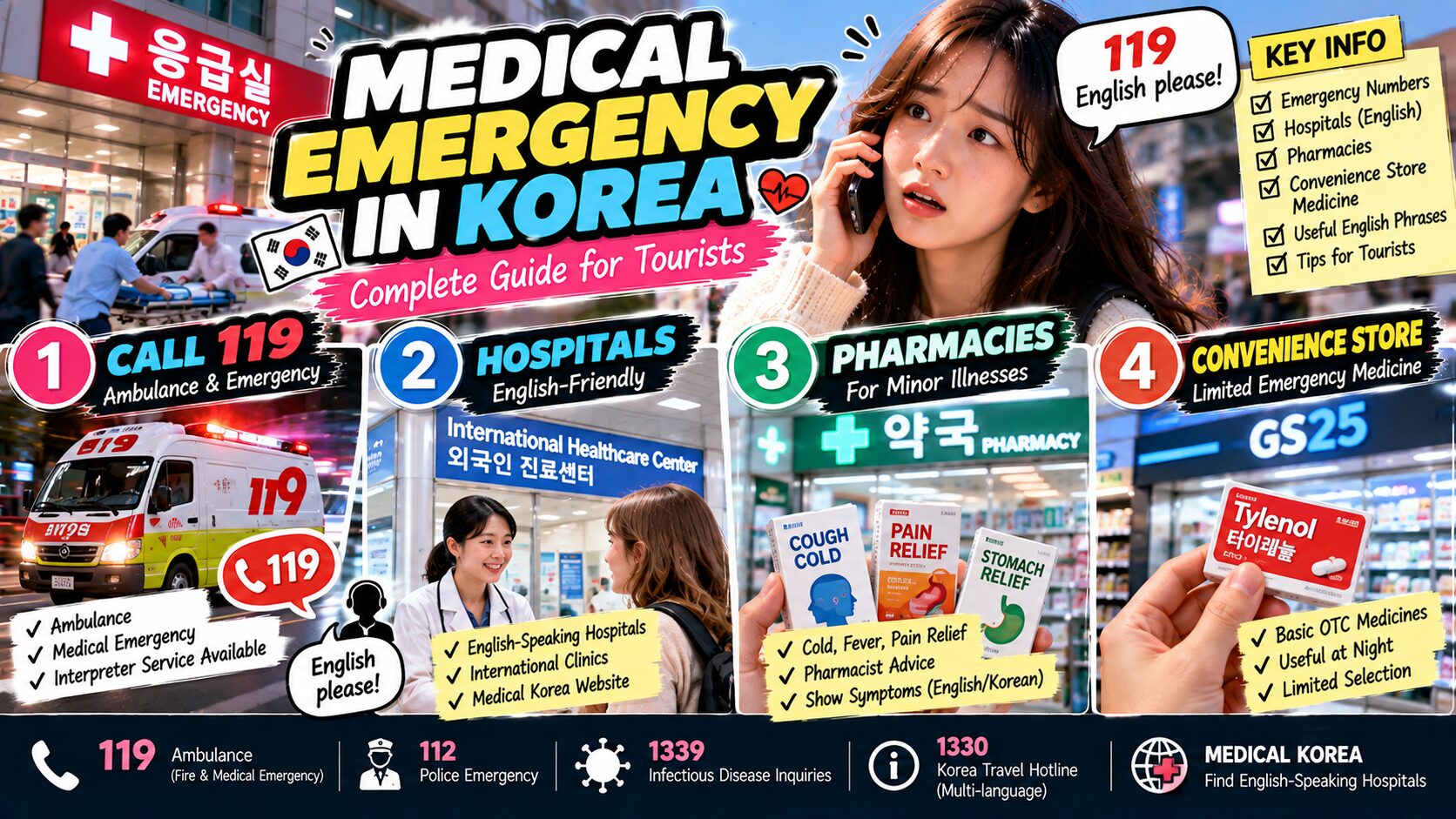
Medical Emergency in Korea: Hospital, Pharmacy & 119 Guide
A medical emergency in Korea can feel much more stressful when you don’t speak Korean or know how the local healthcare system works.
But the basic system is actually fairly simple.
For a serious or life-threatening problem, call 119.
For an illness that needs medical attention but isn’t immediately life-threatening, visit a clinic or hospital.
For minor symptoms such as a headache, cold or indigestion, a pharmacy may be enough.
And late at night, Korean convenience stores carry a limited range of designated emergency medicines.
Here’s what foreign travelers should know.
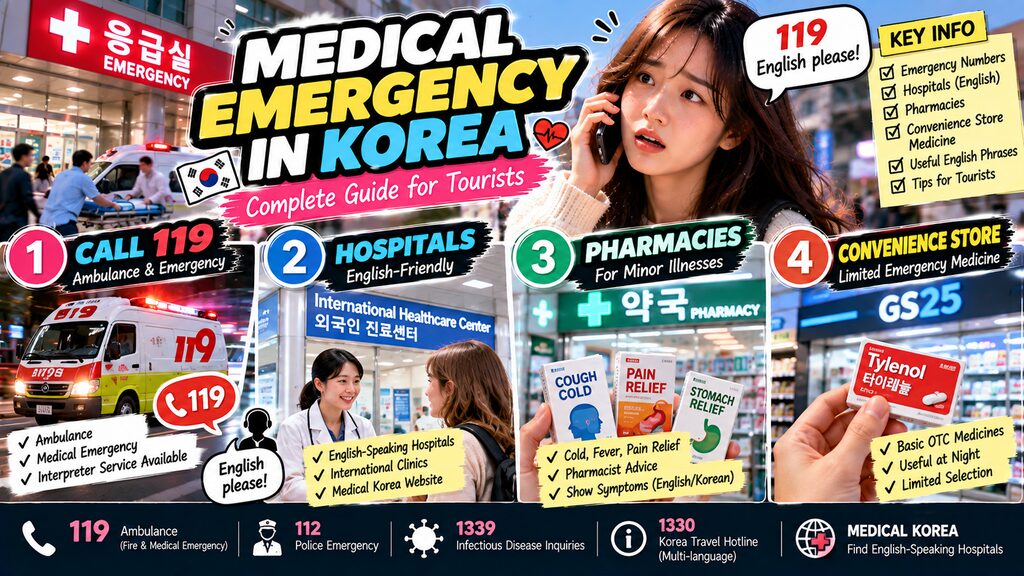
Quick Emergency Guide
| Situation | What to Do | Number / Place |
|---|---|---|
| Serious injury, breathing difficulty, loss of consciousness | Call an ambulance | 119 |
| Police emergency | Call police | 112 |
| Infectious disease questions | Contact KDCA | 1339 |
| Travel assistance / interpretation | Korea Travel Hotline | 1330 |
| Need hospital for foreign patients | Search Medical Korea | Hospital / International Center |
| Mild illness | Visit a pharmacy | Look for 약국 |
| Late-night minor symptoms | Registered convenience store | Limited safety medicines |
Official Korean tourism guidance lists 119 for fire and medical emergencies, 112 for police and 1339 for infectious-disease emergencies. VISITKOREA – Imagine Your Korea
1. Call 119 for a Real Medical Emergency
If someone is seriously injured or suddenly becomes critically ill, call:
119
The number is used for:
- Ambulance
- Fire
- Medical emergencies
You do not need a separate ambulance number.
If you don’t speak Korean, say:
“English please.”
or:
“Interpreter please.”
Korea Tourism Organization’s current safety guidance says 119 can connect international visitors with professional interpretation support. VISITKOREA – Imagine Your Korea
2. Tell 119 Where You Are First
In an emergency, location is one of the most important pieces of information.
Try to provide:
Hotel name
Building name
Street or nearby landmark
Subway station
Floor or room number if relevant
If pronunciation is difficult, open Naver Map or KakaoMap and show the Korean address to someone nearby who can help.
Official tourist safety guidance recommends using nearby buildings or your smartphone GPS to help identify your location quickly. VISITKOREA – Imagine Your Korea
3. Useful English for Calling 119
Keep it short.
“I need an ambulance.”
“Someone is unconscious.”
“I can’t breathe.”
“There has been an accident.”
“I am at [hotel name].”
“English please.”
You don’t need perfect grammar.
Emergency operators need to know:
What happened
Where you are
How many people need help
4. 1339 Is Not a Replacement for 119
This is important because older Korea travel guides can be confusing.
Current VISITKOREA emergency information lists:
119 → Medical emergencies
1339 → Infectious disease emergencies / inquiries. VISITKOREA – Imagine Your Korea
So if somebody collapses, is seriously injured or needs an ambulance:
Call 119.
Don’t waste critical time trying several different medical-information numbers.
5. Use 1330 for Non-Emergency Tourist Help
The Korea Travel Hotline is:
1330
From overseas:
+82-2-1330
It provides tourist assistance in multiple languages, including English, Japanese and Chinese, plus several additional languages. VISITKOREA – Imagine Your Korea
This is useful when the problem isn’t immediately life-threatening but you need help understanding where to go.
For example:
“I need help finding a nearby medical facility.”
is very different from:
“My friend can’t breathe.”
The second one is 119.
6. How to Find an English-Speaking Hospital
For a non-emergency illness, don’t automatically go to the largest emergency room in Seoul.
Look for:
International Clinic
International Healthcare Center
International Patient Center
Many major Korean hospitals operate dedicated services for international patients.
VISITKOREA notes that large hospitals frequently have international healthcare centers with staff and interpreters who can help with appointments, treatment and follow-up. VISITKOREA – Imagine Your Korea
7. Use Medical Korea to Search for Hospitals
One of the best official resources is Medical Korea.
Its hospital database allows users to search medical institutions and filter for interpretation services including:
- English
- Japanese
- Chinese
- Russian
- Arabic
- Vietnamese
- Thai
- Spanish
- Other languages
Medical Korea currently maintains listings of registered medical institutions that treat foreign patients. Medical Korea
This is much more reliable than randomly searching “English hospital near me” and hoping the receptionist speaks English.
8. Medical Korea Support Center Can Also Help
Foreign patients can also contact the Medical Korea Support Center.
Current official tourism information lists:
Medical Korea Support Center
+82-1577-7129
The service can provide assistance related to medical care for international patients. VISITKOREA – Imagine Your Korea
For a serious emergency, however, call 119 first.
9. Bring Your Passport to the Hospital
Keep your passport or another accepted ID available when seeking medical treatment.
Hospitals may need identification for registration, billing or insurance documentation.
Seoul’s official medical guidance includes passports among accepted identification documents for medical institutions. Official Website of the
Also bring:
- Travel insurance information
- List of current medications
- Known drug allergies
- Relevant medical documents
- Emergency contact details
A photo of medication packaging can also be useful.
10. Hospital or Pharmacy?
You don’t necessarily need a hospital for every minor problem.
| Situation | Better First Option |
|---|---|
| Minor headache | Pharmacy |
| Mild cold symptoms | Pharmacy |
| Indigestion | Pharmacy |
| Mild muscle pain | Pharmacy |
| Persistent high fever | Clinic / hospital |
| Severe abdominal pain | Clinic / hospital |
| Major injury | Hospital / 119 |
| Breathing difficulty | 119 |
| Loss of consciousness | 119 |
| Serious allergic reaction | 119 |
When symptoms are severe, rapidly worsening or potentially dangerous, don’t delay professional medical care.
11. Korean Pharmacies Are Easy to Recognize
Look for the Korean word:
약국
This means:
Pharmacy
You can usually find pharmacies near:
- Subway stations
- Hospitals
- Shopping districts
- Residential neighborhoods
Pharmacists can recommend non-prescription medicines for minor symptoms.
VISITKOREA recommends using translation apps and, when helpful, showing a photo of medication you’ve used before. VISITKOREA – Imagine Your Korea
12. Tell the Pharmacist Your Symptoms
You don’t need to know the name of a Korean medicine.
Explain the symptom.
Useful phrases:
| Korean | Meaning |
|---|---|
| 머리가 아파요 | I have a headache |
| 배가 아파요 | My stomach hurts |
| 열이 나요 | I have a fever |
| 감기인 것 같아요 | I think I have a cold |
| 설사를 해요 | I have diarrhea |
| 알레르기가 있어요 | I have an allergy |
| 영어 가능하세요? | Do you speak English? |
Papago can handle longer explanations if necessary.
13. Tell the Pharmacist About Allergies and Other Medicines
This matters much more than speaking perfect Korean.
If you have:
Drug allergies
Chronic health conditions
or
Other medicines you’re currently taking
tell the pharmacist.
Showing a photo of the packaging or active ingredient can be extremely helpful.
VISITKOREA also recommends bringing documentation or an English prescription for travelers who require more complex medication. VISITKOREA – Imagine Your Korea
14. Convenience Stores Sell Only Limited Medicines
Korean convenience stores are not mini pharmacies.
Registered 24-hour stores may sell a limited category of designated safety OTC medicines.
Current government guidance lists 13 approved products across categories such as:
- Fever and pain relief
- Cold medicine
- Digestive medicine
- Pain-relief patches
The system exists mainly so people can buy basic medicine when pharmacies are closed. 보건복지부
You won’t find the full range of medicines available at a pharmacy.
15. Convenience Store vs Pharmacy
| Convenience Store | Pharmacy |
|---|---|
| Limited designated medicines | Much wider OTC selection |
| Useful late at night | Pharmacist available |
| Pain/fever medicine | Can recommend medicine based on symptoms |
| Cold medicine | Allergy medicine and other OTC options may be available |
| Digestive medicine | Prescription dispensing |
| Pain patches | Better for complicated symptoms |
If it’s 2 AM and you have a mild headache, a convenience store can be useful.
If you’re unsure what medicine you need, I’d choose a pharmacy whenever possible.
16. Prescription Medicines Require a Proper Prescription
Some medicines cannot simply be purchased by asking the pharmacist.
Prescription-only drugs require a prescription from an appropriate medical provider in Korea.
So don’t assume:
“I use this prescription medicine in my country, so a Korean pharmacy will give me the same thing.”
If you rely on an important prescription medication, bring enough for your trip when legally permitted and keep relevant medical documentation with you.
17. How to Find a Late-Night Pharmacy
If the pharmacy beside your hotel is closed, look for a duty or late-night pharmacy.
VISITKOREA recommends Korea’s pharmacy search services for locating pharmacies open during evenings, weekends and holidays. VISITKOREA – Imagine Your Korea
You can also ask your hotel reception.
Useful phrase:
“Is there a pharmacy open now?”
In Korean:
지금 문 연 약국이 있어요?
“Is there a pharmacy open now?”
18. Don’t Go to an Emergency Room Just Because a Pharmacy Is Closed
Emergency rooms are for genuine emergencies and urgent medical situations.
If you only need basic cold medicine, try:
Late-night pharmacy
↓
Registered convenience store
before using a major hospital emergency department solely because normal stores are closed.
Of course, if symptoms are severe or concerning, seek urgent medical care.
19. Travel Insurance Is Worth Having
Foreign travelers may have to pay medical costs directly and then claim reimbursement depending on their insurance.
Keep:
Hospital receipts
Prescription receipts
Medical certificates
Diagnosis information
Your insurer may require them later.
If you have travel insurance, save the emergency-assistance number somewhere separate from the insurance app.
20. What to Do During a Medical Emergency in Korea
For a serious medical emergency in Korea, remember this order:
1. Call 119
↓
2. Say “English please” if necessary
↓
3. Give your exact location
↓
4. Explain the symptoms briefly
↓
5. Follow the operator’s instructions
↓
6. Prepare your passport and medical information
↓
7. Contact travel insurance when appropriate
Don’t delay an ambulance because you’re worried about explaining everything perfectly.
21. Useful Numbers to Save Before Your Trip
| Number | Service |
|---|---|
| 119 | Ambulance / fire / medical emergency |
| 112 | Police |
| 1339 | Infectious-disease information |
| 1330 | Korea Travel Hotline |
| 1577-7129 | Medical Korea Support Center |
Screenshot this table before your trip.
You probably won’t need it.
But if you do, you’ll be glad you have it.
22. Simple Medical Kit for Korea Travel
You don’t need to pack a pharmacy into your suitcase.
A small kit can include items you personally know you can safely use, such as:
- Regular prescription medication
- Basic first-aid supplies
- Personal allergy medication
- Medication documentation
- Travel insurance details
Keep prescription medicines in their original packaging when possible.
For unfamiliar medicines, ask a qualified pharmacist or clinician rather than guessing based on packaging.
FAQ
What number should I call for an ambulance in Korea?
Call 119 for an ambulance or medical emergency. Foreign visitors can request interpretation by saying “English please” or “Interpreter please.” VISITKOREA – Imagine Your Korea
Is 1339 Korea’s ambulance number?
No. Current official tourism guidance lists 119 for medical emergencies and 1339 for infectious-disease emergencies or inquiries. VISITKOREA – Imagine Your Korea
Can I find English-speaking hospitals in Korea?
Yes. Many larger hospitals operate international healthcare centers, and Medical Korea allows users to search institutions by available interpretation language. Medical Korea
Can I buy medicine at a Korean convenience store?
Yes, but only a limited list of designated safety OTC medicines is sold at registered stores. For a wider selection and pharmacist advice, visit a pharmacy. 보건복지부
Can Korean pharmacists speak English?
It varies. Pharmacies in major tourist areas may have English-capable staff, but using Papago and showing photos of your medicine or symptoms can help. VISITKOREA – Imagine Your Korea
Should I carry my passport to the hospital?
Yes, bringing your passport and insurance information is a sensible choice when seeking medical care as a foreign traveler.
Final Thoughts
Preparing for a medical emergency in Korea doesn’t mean expecting something bad to happen.
It simply means knowing which number to call and where to go.
Remember:
119 → serious medical emergency
Pharmacy → minor illness and medicine advice
Convenience store → limited emergency OTC medicines
Medical Korea → find hospitals that treat international patients
1339 → infectious-disease information
Save those numbers, keep your passport and insurance information accessible, and install a translation app before your trip.
Those few preparations can turn a very stressful situation into something much easier to manage.
Related Articles
MY NOTE