
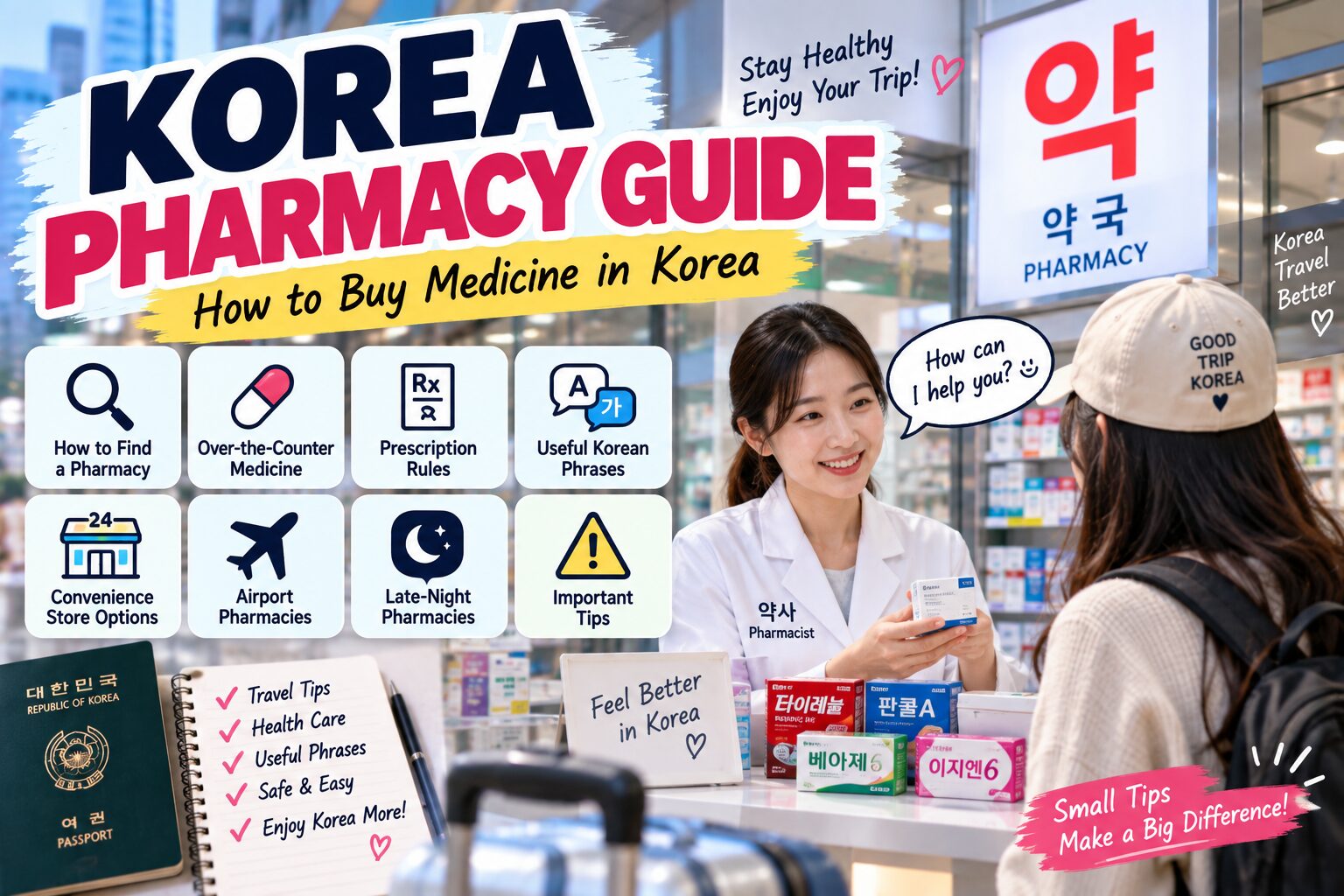
Korea Pharmacy: Complete Guide for Foreign Travelers
If you need to visit a Korea pharmacy during your trip, don’t worry if you can’t speak Korean.
Pharmacies are common throughout Korean cities, and pharmacists can help with many everyday problems such as headaches, indigestion, diarrhea, colds and minor pain. Nonprescription medicines for common conditions are widely available.
The system may work a little differently from what you’re used to, so here are the basics every international traveler should know.
1. How to Find a Pharmacy in Korea
The Korean word for pharmacy is:
약국 (yak-guk)
You’ll often see a large 약 or 약국 sign outside.
Pharmacies are commonly found around subway stations, shopping districts, residential neighborhoods and especially near hospitals and clinics.
In major tourist areas, some pharmacies are accustomed to serving international visitors.
2. You Don’t Need to Know the Korean Name of the Medicine
This is probably the most useful tip.
Instead of trying to translate the exact name of a medicine, explain your symptoms to the pharmacist.
For example:
“I have a headache.”
“I have an upset stomach.”
“I have diarrhea.”
“I have a sore throat.”
“I think I have a cold.”
If communication is difficult, use a translation app.
The Korea Tourism Organization specifically recommends using a translation app to explain what medicine you need, where you have pain and whether you have allergies.
3. Show a Photo of Your Medicine
Already use a particular medicine at home?
Take a photo of the package.
Even if the exact same brand isn’t sold in Korea, a pharmacist may be able to identify the active ingredient or recommend an appropriate Korean alternative.
The Korea Tourism Organization also recommends showing a photo when language becomes a problem.
For regular medication, having photos of the packaging and ingredient information before your trip is a good idea.
4. Tell the Pharmacist About Allergies and Other Medicines
Don’t skip this part.
Before taking a new medicine, tell the pharmacist about relevant allergies and other medicines you’re currently using.
A simple translated note on your phone can help:
My symptoms:
My allergies:
Medicines I’m currently taking:
Medical conditions the pharmacist should know about:
You can prepare this before leaving home.
It takes a minute and can make communication much easier.
5. Some Medicines Require a Prescription
Not everything can simply be purchased over the counter.
For medicines that require a Korean prescription, you’ll generally need to visit a clinic or hospital first and then take the prescription to a pharmacy.
If you have an existing condition requiring more complicated prescription medication, the Korea Tourism Organization recommends preparing medical records and an English prescription before traveling.
Don’t assume that a prescription from another country automatically means the exact same medicine can simply be dispensed in Korea.
6. Can You Buy Medicine at Convenience Stores?
Some basic nonprescription medicines are also available at designated convenience stores, which can be useful when pharmacies are closed. Korea Tourism Organization travel guidance notes that certain nonprescription medicines can be purchased at pharmacies and some convenience stores.
However, the selection is much more limited.
If a pharmacy is open, I’d generally choose the pharmacy because you can explain your symptoms and ask a pharmacist for guidance.
Think of convenience stores as a useful backup for certain basic products rather than a replacement for a pharmacy.
7. What If You Need Medicine Late at Night?
This is where planning helps.
Not every Korea pharmacy stays open late, and operating hours vary significantly between locations.
Korea has duty and late-night pharmacies, and the Korean Pharmaceutical Association provides services for finding pharmacies operating during nights, weekends and holidays.
If you start feeling sick in the evening, don’t automatically assume the pharmacy you saw earlier will still be open.
Check before traveling there.
8. Airport Pharmacies Can Be Useful
Forgot to buy medicine before your flight?
Major Korean airports also have pharmacies.
The Korea Tourism Organization’s pharmacy guide notes pharmacy locations at both Gimpo and Incheon airports, including multiple pharmacy locations across Incheon Airport’s terminals.
This can be useful for picking up basic travel medicine before continuing your journey.
However, if you’re already staying in Seoul or Busan, there’s usually no reason to wait until you reach the airport.
9. Don’t Buy Medicine Based Only on Viral Social Media Posts
Korean pharmacy products sometimes become popular online.
But medicine isn’t the same thing as buying a viral Korean snack or cosmetic.
Something that worked well for another traveler may be unsuitable for you because of your medical history, allergies, dosage or other medicines you’re taking.
Show the product to a pharmacist and ask whether it’s appropriate for you.
The Korean Ministry of Food and Drug Safety also publishes multilingual information about commonly used over-the-counter medicines, including information on usage, side effects and precautions.
10. Be Careful When Taking Medicine Across Borders
Buying something legally at a Korean pharmacy doesn’t automatically mean you can freely bring unlimited quantities into another country.
Rules differ depending on the medicine and your destination.
Korea itself also restricts the import and export of certain medicines that can be misused or abused.
If you’re buying medication to take home rather than use during your trip, check the customs and medication rules of your destination country first.
Useful Korean Pharmacy Phrases
You don’t need to memorize Korean, but these can help:
약국 어디예요?
Yak-guk eodi-yeyo?
Where is the pharmacy?
감기약 주세요.
Gamgi-yak juseyo.
Cold medicine, please.
두통이 있어요.
Dutongi isseoyo.
I have a headache.
배가 아파요.
Baega apayo.
My stomach hurts.
알레르기가 있어요.
Allereugiga isseoyo.
I have an allergy.
When in doubt, simply use Papago or another translation app and show the screen to the pharmacist.
Pharmacy or Hospital?
For minor symptoms, asking a pharmacist may be a reasonable first step.
But a pharmacy isn’t a substitute for medical evaluation when symptoms are severe, unusual or worsening.
If you need prescription treatment or a proper diagnosis, visit a clinic or hospital.
And for an emergency, seek emergency medical assistance rather than searching for an open pharmacy.
Final Thoughts
Using a Korea pharmacy is usually much easier than first-time visitors expect.
You don’t need to know Korean medicine brands or speak fluent Korean.
Explain your symptoms, use a translation app, show photos of medicines you already take and tell the pharmacist about allergies or other medications.
For prescription medicines or more serious symptoms, visit a medical clinic instead.
Knowing these basics before your trip means that if you suddenly feel sick in Korea, figuring out what to do won’t become another travel headache.