
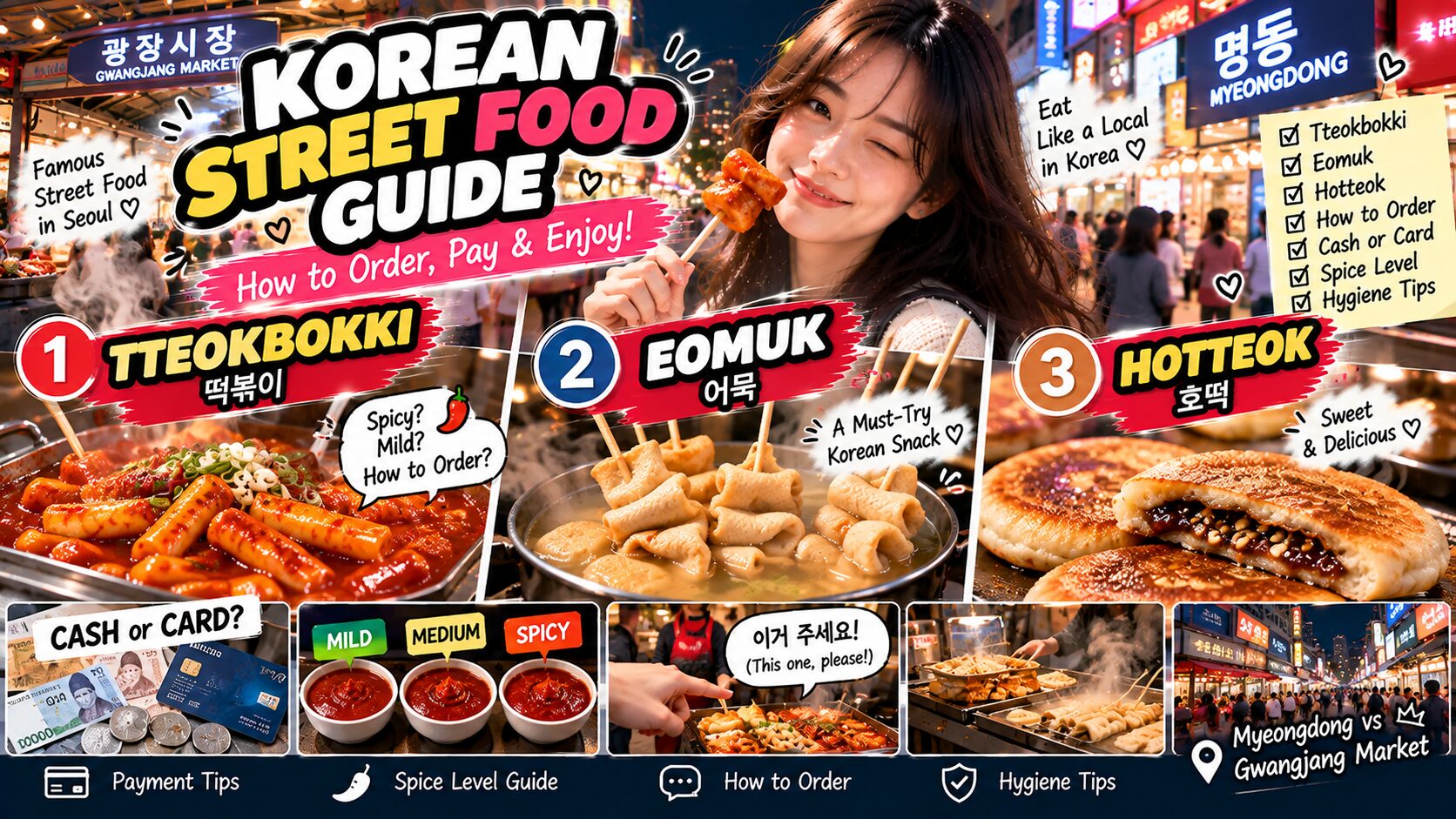
Korean Street Food Guide: Ordering, Cash & Hygiene Tips
A Korean street food guide can make your first visit to places like Myeongdong or Gwangjang Market much easier.
Korean food stalls can look chaotic at first.
There may be no obvious line, the menu may be entirely in Korean, food is prepared right in front of you, and you’re suddenly wondering whether you should pay before or after eating.
The good news is that ordering is usually very simple.
Point at what you want, check the price, pay using the accepted method and enjoy.
Here are the basic rules foreign travelers should know.
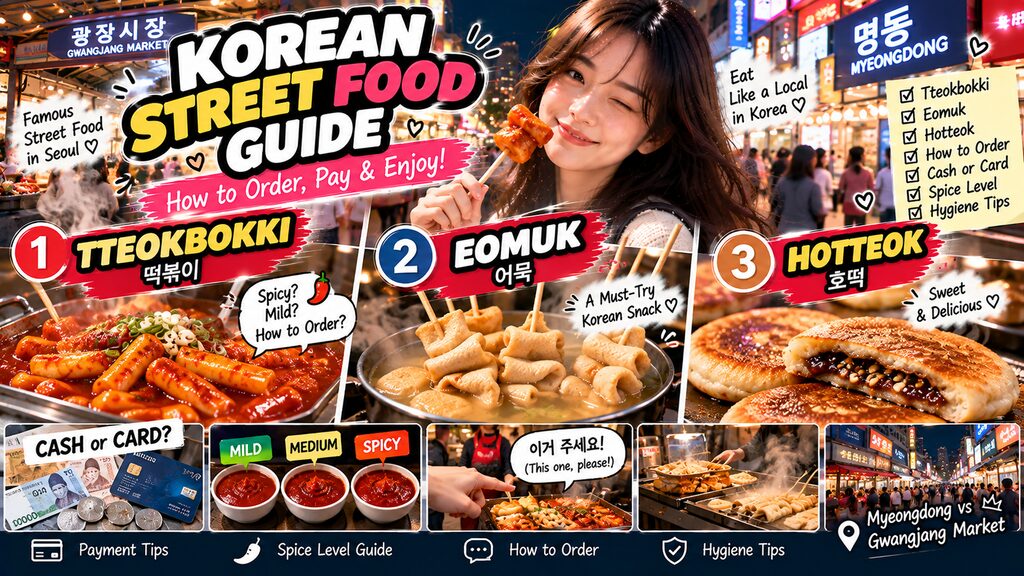
1. Start With These Three Korean Street Foods
For a first visit, these are some of the easiest choices.
| Food | Korean | Flavor | Good for Beginners? |
|---|---|---|---|
| Tteokbokki | 떡볶이 | Sweet, spicy | Yes, if you like spice |
| Eomuk | 어묵 | Savory, mild | Very easy |
| Hotteok | 호떡 | Sweet | Very easy |
Tteokbokki is probably the most recognizable.
Eomuk is a much safer choice if spicy Korean food worries you.
Hotteok works well as dessert, especially in cooler weather.
2. How to Order Tteokbokki
The easiest method is pointing.
Say:
이거 주세요.
Igeo juseyo.
“This one, please.”
If you want one serving:
떡볶이 1인분 주세요.
Tteokbokki il-inbun juseyo.
“One serving of tteokbokki, please.”
If the stall is busy, you usually don’t need a complicated conversation.
Point + quantity works perfectly well.
3. How to Order Eomuk
Eomuk is Korean fish cake, often served on a skewer.
You may see it sitting in hot broth.
Order one by saying:
어묵 하나 주세요.
“One eomuk, please.”
At some stalls, you eat the skewers first and the vendor counts them afterward.
At others, you pay immediately.
Watch what nearby customers are doing before assuming.
4. How to Order Hotteok
Hotteok is a fried or griddled pancake usually filled with sweet syrup, sugar, nuts or seeds.
Simply point and say:
호떡 하나 주세요.
“One hotteok, please.”
Be careful with the first bite.
Fresh hotteok filling can be extremely hot.
Waiting a minute is much better than burning your mouth five minutes into your Myeongdong food tour.
5. Cash or Card?
This is one of the most common questions.
Korea is highly card-friendly, but small street stalls can operate differently from regular restaurants.
Some vendors accept:
- Credit cards
- Korean mobile payments
- Cash
while others may prefer or accept only cash.
So don’t assume every stall works the same way.
The easiest question is:
카드 돼요?
Kadeu dwaeyo?
“Can I pay by card?”
If not, the vendor may say:
현금만 돼요.
“Cash only.”
6. Carry Some Small Korean Won
You don’t need to carry a huge amount of cash just for street food.
Something like:
₩1,000 notes
₩5,000 notes
₩10,000 notes
is useful.
Trying to pay for a ₩2,000 snack with a ₩50,000 note is possible, but not always convenient for a small stall.
If you’re planning a market-food day, small bills make everything smoother.
7. Pay Before or After Eating?
There is no universal rule.
Some stalls expect:
Order → Pay → Eat
Others operate:
Order → Eat → Pay
And skewer-based food sometimes works by counting how many skewers you used.
If you’re unsure, just hold up your card or cash after ordering.
The vendor will usually tell you immediately whether to pay now or later.
8. How Spicy Is Tteokbokki?
This is difficult to answer because every shop uses a different sauce.
Some tteokbokki is sweet with moderate heat.
Some is seriously spicy.
The color alone isn’t always enough to judge it.
If you’re sensitive to chili, ask before ordering.
9. Useful English Expressions for Spicy Food
At tourist-friendly stalls, simple English works better than complicated sentences.
| What You Want | Easy English |
|---|---|
| Ask about spice | “Is this spicy?” |
| Ask how spicy | “How spicy is it?” |
| Request mild food | “Can you make it less spicy?” |
| Request no spice | “Do you have a non-spicy one?” |
| Ask for mild sauce | “Less sauce, please.” |
| Say you can’t eat spicy food | “I can’t eat spicy food.” |
Keep it simple.
“Could you perhaps reduce the overall capsaicin intensity?” is technically English.
It is not useful English ㅋㅋ.
10. Useful Korean Expressions for Spice Level
These are even more effective.
| Korean | Meaning |
|---|---|
| 이거 매워요? | Is this spicy? |
| 많이 매워요? | Is it very spicy? |
| 덜 맵게 해 주세요 | Please make it less spicy |
| 안 매운 거 있어요? | Do you have something not spicy? |
| 소스 조금만 주세요 | Please use only a little sauce |
| 저 매운 거 못 먹어요 | I can’t eat spicy food |
The most useful one is:
많이 매워요?
If the vendor immediately laughs before answering, prepare yourself ㅋㅋ.
11. Not Every Street Food Can Be Made Less Spicy
This is important.
For dishes prepared individually, the vendor may be able to reduce sauce.
But tteokbokki is often already cooking in a large shared pan.
In that situation, they can’t magically remove the chili from your portion.
Your options may simply be:
- Eat a small portion
- Choose a milder stall
- Order eomuk instead
- Pick another food
So “less spicy” is a request, not a guarantee.
12. How to Choose a Cleaner Food Stall
Street food always involves some judgment.
A few practical signs are useful.
Look for stalls where:
- Food turnover is fast
- Ingredients look fresh
- Cooked and raw food are handled separately
- Food is kept hot when it should be hot
- The stall appears generally organized
- Many customers are actively ordering
A long line isn’t automatic proof of perfect hygiene, but high turnover often means food doesn’t sit around for long periods.
13. Be More Careful With Raw Food
Cooked tteokbokki, hot fish cake and freshly grilled pancakes are relatively straightforward.
Raw or lightly cooked seafood requires more caution.
If you’re unsure about food handling, choose food that is:
Cooked thoroughly
and
served hot
especially if you have a sensitive stomach.
You don’t need to try something simply because TikTok told you it’s “must-eat Korean food.”
14. Watch Where the Tongs Go
At some stalls, customers may use shared tongs.
Pay attention to whether utensils used for raw ingredients are being mixed with ready-to-eat food.
Well-run stalls usually separate tools and ingredients.
If something looks questionable, there are hundreds of other food stalls in Seoul.
Just move on.
15. Hot Food Should Actually Be Hot
For cooked foods such as:
Tteokbokki
Eomuk
Mandu
Fried snacks
Pancakes
I’d generally choose stalls where the food is being actively cooked or reheated.
Freshly prepared food also usually tastes better anyway.
That makes hygiene and taste point in the same direction.
16. Be Careful With Food Left Exposed for Long Periods
Outdoor markets naturally have more environmental exposure than indoor restaurants.
If food appears to have been sitting uncovered for a long time, especially in hot weather, you don’t need to take the risk.
Choose another vendor with faster turnover.
Markets like Gwangjang have enough options that there’s rarely a reason to force yourself to eat at one specific stall.
17. Don’t Touch Food Before Buying It
Point.
Don’t pick something up with your bare hands to inspect it and then put it back.
This sounds obvious, but food displays in traditional markets can feel very informal.
If you want something, tell the vendor.
18. Myeongdong vs Gwangjang Market
The two areas provide very different street-food experiences.
| Area | Best For | Atmosphere |
|---|---|---|
| Myeongdong | Easy tourist street food | Busy, international |
| Gwangjang Market | Traditional market dishes | Local-market atmosphere |
Myeongdong is easier if this is your first night in Korea.
You’ll see lots of visual menus and vendors accustomed to international travelers.
Gwangjang Market is better if you want a more traditional market atmosphere and dishes such as bindaetteok, gimbap and yukhoe alongside standard street food.
19. Don’t Buy Everything at the First Stall
This is my favorite practical tip in this Korean street food guide.
Walk around first.
One stall may sell tteokbokki for one price while another has a completely different portion or style.
The same goes for:
Hotteok
Mandu
Chicken skewers
Seafood
Fruit
Desserts
Market streets are much more fun when you browse before buying.
20. Order Small Portions and Share
If you’re visiting with someone, don’t buy a full portion from every stall.
Share.
For example:
Tteokbokki
↓
Eomuk
↓
Mandu
↓
Hotteok
This lets you try four foods without reaching the third stall already completely full.
21. Don’t Forget Napkins and Wet Wipes
Korean street food can get messy.
Especially:
Tteokbokki sauce
Hotteok syrup
Chicken skewers
Fried food
Carry a small pack of tissues or wet wipes.
Your white travel outfit will thank you.
22. Check the Price Before Ordering
If the price is clearly displayed, easy.
If not, ask:
얼마예요?
Eolmayeyo?
“How much is it?”
This is more useful than worrying about whether you’re being charged a “tourist price” after you’ve already eaten.
Confirm first.
Then order.
23. Don’t Automatically Bargain for Food
Traditional market does not mean bargaining over everything.
For prepared street food, pay the listed price.
Don’t try:
“₩5,000? How about ₩3,000?”
That’s not normal street-food etiquette.
Bargaining can sometimes occur with certain market goods, clothing or bulk purchases.
Food stalls are different.
24. Have a Backup if You Can’t Handle Spicy Food
A good street-food plan isn’t:
“I’ll force myself through five spicy dishes because I’m in Korea.”
Mix spicy and mild food.
Good mild options include:
Eomuk
Hotteok
Gimbap
Some dumplings
Grilled sweet potato
That makes the entire food tour much more enjoyable.
Quick Street Food Checklist
| Before Ordering | What to Check |
|---|---|
| Price | Is it clearly displayed? |
| Payment | Cash or card? |
| Spice | Can you handle the level? |
| Hygiene | Is food fresh and actively cooked? |
| Portion | Can you share it? |
| Seating | Is it takeaway or eat-at-stall? |
FAQ
Do Korean street food stalls accept credit cards?
Many do, but not all. Carrying some Korean cash is still useful for small vendors.
Is street food in Korea safe?
Most travelers eat Korean street food without problems, but use normal food-safety judgment. Choose busy, clean stalls with fresh ingredients and good food turnover.
Is tteokbokki very spicy?
It depends on the stall. Some versions are fairly sweet and mild, while others can be extremely spicy.
How do I ask for less spicy food?
Say:
덜 맵게 해 주세요.
“Please make it less spicy.”
But some pre-cooked foods can’t be individually adjusted.
What is the easiest Korean street food for beginners?
Eomuk and hotteok are among the easiest choices if you’re worried about spice.
Is Gwangjang Market better than Myeongdong for street food?
Gwangjang is better for a traditional market-food experience. Myeongdong is easier and more tourist-oriented.
Final Thoughts
A Korean street food guide doesn’t need to be complicated.
Check the price before ordering, carry some small cash, ask whether card payment is accepted and don’t be embarrassed to ask how spicy something is.
For hygiene, choose stalls with good turnover, freshly cooked food and clean handling practices.
Start with tteokbokki, eomuk and hotteok, then explore whatever catches your eye.
You don’t need fluent Korean.
Pointing, 이거 주세요, 얼마예요? and 많이 매워요? will take you surprisingly far.
Related Articles
MY NOTE